
Groin pain in adults – a practical approach to a complex problem
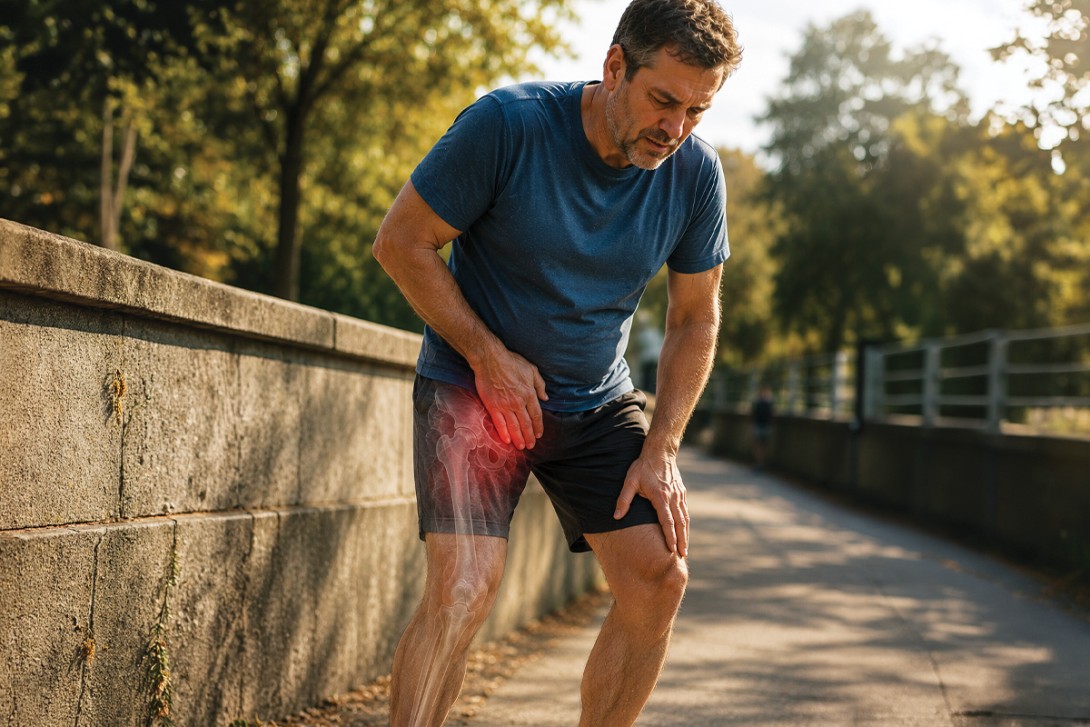
Groin pain is a common but diagnostically complex presentation, with a wide range of musculoskeletal and nonmusculoskeletal causes. Although a specific diagnosis is important in selected cases, it may not alter management in many patients. Load management remains the cornerstone of treatment, and investigations such as x-ray, ultrasound and MRI are rarely required first line but should be considered when symptoms fail to improve with initial conservative management.
- The groin is a diagnostically complex region, but it is debatable whether diagnostic specificity improves outcomes in many cases.
- Although groin pain in young athletes is commonly caused by muscle strains, tendinopathy and bone stress injuries
(e.g. osteitis pubis), hip joint pathology can occur at all ages. - Hip osteoarthritis is the most common cause of groin pain in older adults.
- Load management is the first-line treatment for groin pain in the majority of patients.
- MRI is the most comprehensive imaging modality for assessment of the hip and groin. However, it should generally be reserved for excluding serious pathology or for cases in which interventional management is being considered.
- Plain x-ray is often a more appropriate initial investigation in older patients who may benefit from interventional treatment, particularly hip replacement surgery.
- The management of groin pain in the community should increasingly mirror that of back pain, with load management as the primary treatment and imaging used selectively to minimise the risk of overmedicalisation.
The groin is one of the most diagnostically complex regions in musculoskeletal medicine, with a broad range of potential causes of pain.1 There is also ongoing uncertainty about whether establishing a specific anatomical diagnosis changes management in the majority of cases. The value of a specific diagnosis is often clearer in mid- to distal-limb musculoskeletal conditions. By contrast, in adult back pain, there is increasing recognition that best-practice management is frequently independent of anatomical diagnosis.2-4 Groin pain, with the hip joint casting a large diagnostic shadow, lies somewhere between these examples. Some presentations have important specific diagnoses, such as hip osteoarthritis in the older adult, whereas many others are best managed using broader principles similar to those used in back pain.
Traditionally, clinicians are trained to approach musculoskeletal presentations through history taking, followed by physical examination and then special investigations. In sport and exercise medicine, investigations may include imaging, pathology and, increasingly, data from wearable devices.5 These components form part of the diagnosis, which then informs management. First-line management usually involves lifestyle measures and simple medications, with injections and surgery reserved for selected cases. There is increasing recognition that lifestyle and noninvasive strategies are underused, whereas medications and surgery are often overused in musculoskeletal medicine.6
History and initial assessment
Even in the era of readily accessible MRI, history-taking remains the most important part of assessment and should take priority. Important questions include whether the primary symptom is pain or another symptom such as swelling, numbness or weakness, and whether symptoms are associated with urinary, gastrointestinal or gynaecological complaints.
With respect to pain, clinicians should determine:
- whether symptoms relate to sport, exercise or musculoskeletal loading
- whether activity is limited by symptoms
- symptom duration and temporal pattern
- whether symptoms fluctuate with changes in load
- whether onset was sudden or gradual
- whether the patient has continued activity despite pain.
The history is often the most important clue as to whether groin pain symptoms arise from the musculoskeletal system or represent referred pain from another organ system.
There is a small but important overlap with potentially serious diagnoses, including testicular cancer in young men, prostate cancer in older men, gynaecological cancer in women, and more severe musculoskeletal diagnoses, such as hip osteonecrosis, strangulated hernia and femoral neck stress fracture.
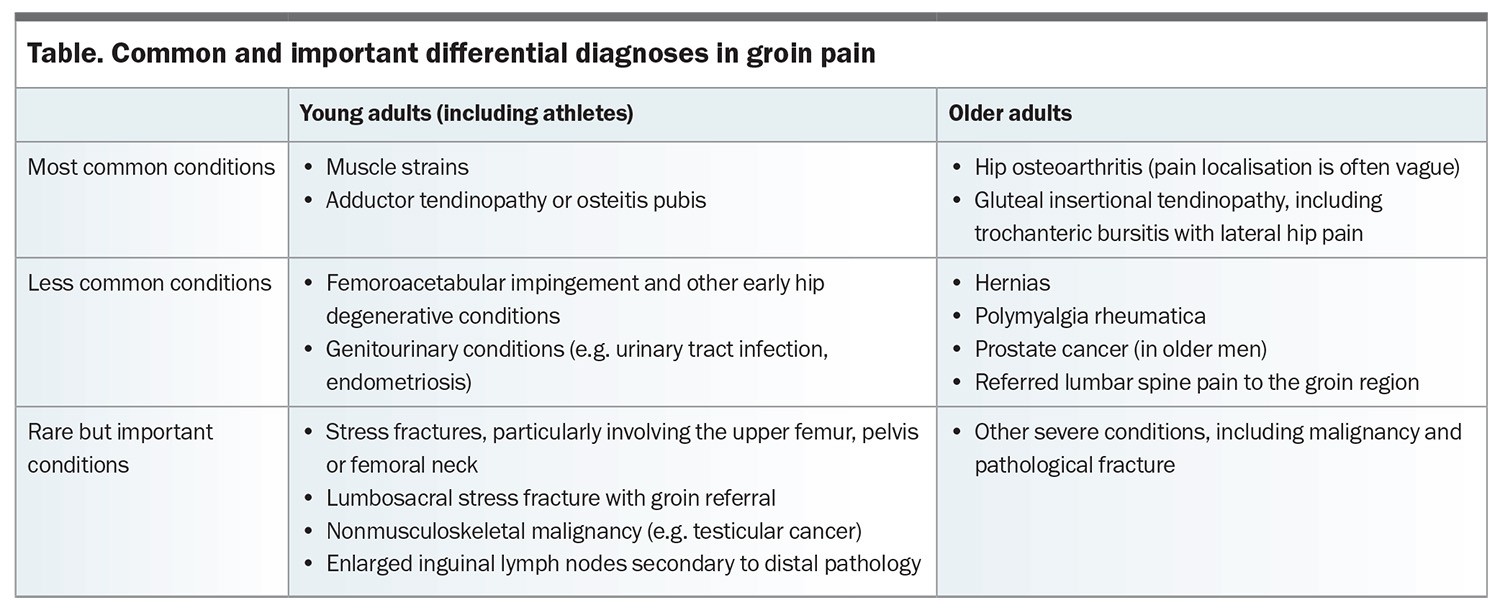
Typical musculoskeletal pain will be worse with activity and temporarily improved by rest. Symptoms usually have either an obvious association with loading (e.g. sudden onset during sport) or a more subtle association, such as gradual onset after increased walking or lifting. Important musculoskeletal and nonmusculoskeletal differential diagnoses are summarised in the Table.
Rethinking the traditional diagnostic approach
Traditional teaching suggests that physical examination follows the history and helps formulate a differential diagnosis. However, given the large number of possible diagnoses and examination tests, it may be more practical to begin considering management strategies based on the history before progressing to examination and investigations.
In selected cases, genital examination is appropriate, but this may also represent an unnecessary invasion of privacy in low-yield situations.7 Clinicians should therefore ask whether an examination or investigation is likely to alter management meaningfully. Where intimate examination is indicated, a chaperone should be offered.
Physical examination and imaging remain important parts of assessment but should be directed towards likely diagnoses and management options.
Management options for groin pain
Load management
The initial management of most musculoskeletal conditions is conservative. The term load management best describes high-quality conservative management.
Although randomised controlled trials have examined conservative management programs for groin pain, such as exercise programs, load management usually needs to be individualised.8,9 Studies in elite athletes have shown that constant moderate loading is protective against injury, whereas sudden increases in load increase injury risk.10-12 These findings have influenced modern rehabilitation approaches, where injury management typically involves an initial unload period followed by gradual, progressive reloading. Ideally, rehabilitation programs for community athletes and nonathletes should follow the same principles. This underpins physiotherapy exercise programs that gradually increase repetitions and resistance.13
In some cases, however, patients report worsening pain with prescribed exercises. This should be interpreted in the context of total load. If occupational, household or sporting load remains unchanged, then additional exercises may simply increase overall loading.
Total groin load may include:
- occupational activity
- household tasks
- sport and leisure activity
- rehabilitation exercises
- Pilates or yoga.
Loading is the most beneficial when it follows a period of unloading and then progresses gradually. Physiotherapy-prescribed exercises are therefore best viewed as one component of a broader, graded loading strategy.
The ideal de-load and re-load program is graduated and progresses slowly enough to avoid reinjury (Figure 1a; Goldilocks or tortoise pattern). Common patterns of unsuccessful reloading after injury are shown in Figures 1b, 1c and 1d (hare, mule and sloth patterns). These analogies can help explain to patients why deviation from the ideal program may lead to lower success rates. The tortoise versus hare analogy helps explain why slower rehabilitation is often associated with greater success and lower recurrence rates than more rapid rehabilitation. Successful rehabilitation, with sufficient progression to allow for restrengthening, can be considered to occur within the Goldilocks zone (not too high or fast and not too low or slow). Unsuccessful rehabilitation may occur if baseline load does not decrease sufficiently (the mule pattern; Figure 1c) or if loading remains too low for too long and is not sufficiently challenging (the sloth pattern; Figure 1d). In chronic pain presentations, where patients may have experienced many months or years of unsuccessful conservative treatment, it is not uncommon for management to begin with a mule pattern (persisting through pain for too long) followed by overcorrection into a sloth pattern (physical activity avoidance because of fear of pain).
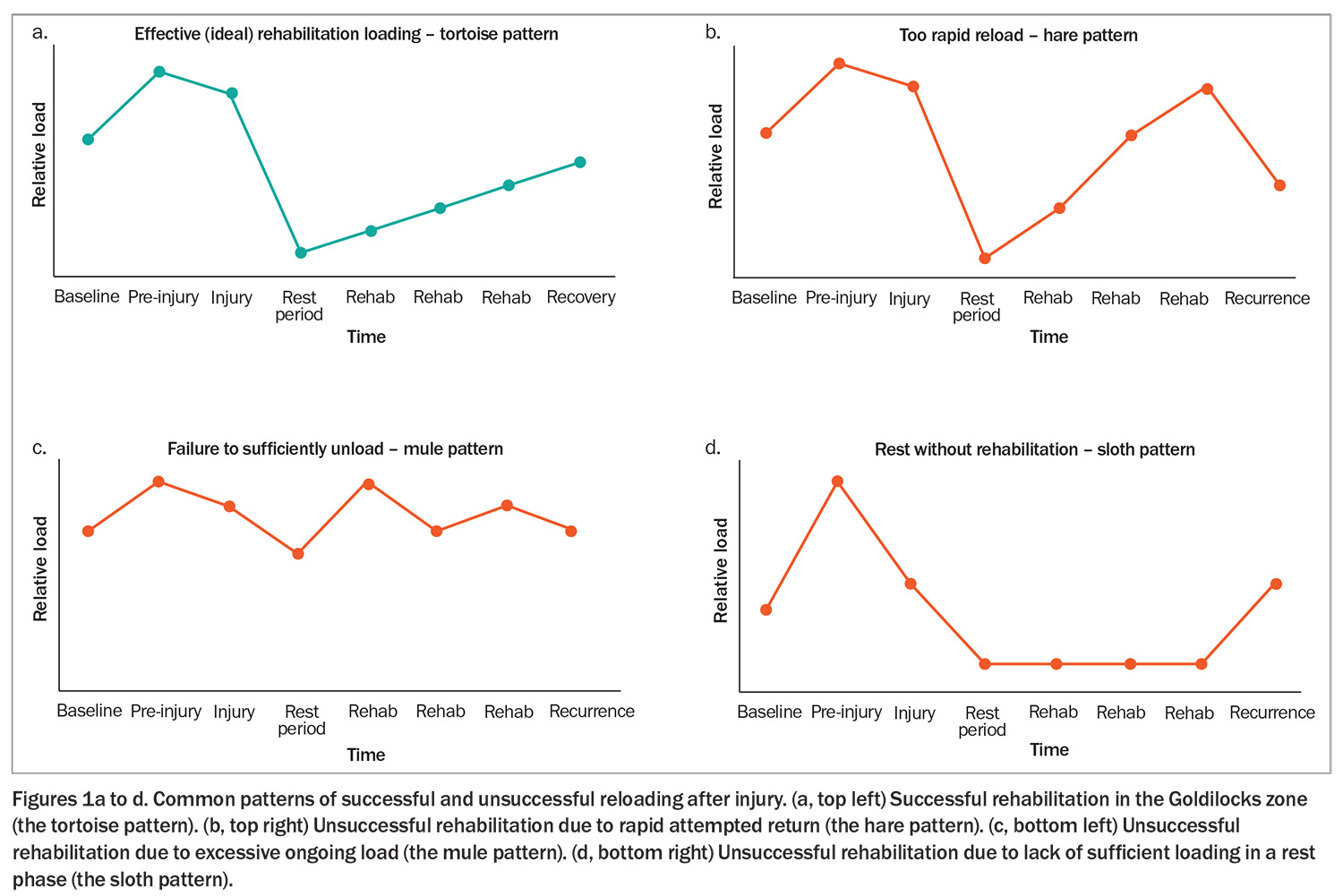
Load (the y-axis) can be relatively easy to calculate in unidirectional athletes, such as runners, swimmers, cyclists and bushwalkers, where weekly distance or daily step counts can be measured objectively.5 However, straight-line running, change of direction, lifting and core work (e.g. rehabilitation exercises, Pilates and yoga) all contribute to groin loading, making total load more difficult to quantify objectively.
Physiotherapists are traditionally the main practitioners involved in prescribing load management programs for musculoskeletal conditions such as groin pain. Other allied healthcare practitioners, including chiropractors, osteopaths and exercise physiologists, may also have expertise in load management. For active individuals, sport and exercise medicine physicians are often the most appropriate specialist referral, whereas occupational physicians and rehabilitation physicians may be more appropriate in their respective contexts.
Corticosteroid injections and pain-relieving medications
Corticosteroid injections and analgesics may provide short-term symptom relief in groin pain, as they do in other musculoskeletal conditions.
For corticosteroid injections, evidence suggests greater pain relief than placebo during the first two to eight weeks after injection.14,15 However, this benefit may be offset by worse medium-term outcomes. When short-term improvement is especially important, such as during a sporting competition, the benefits may outweigh the risks.
The precise injection site may also be less important than previously assumed. For example, intramuscular gluteal corticosteroid injections may provide short-term pain relief in hip osteoarthritis.16
If analgesics are used, paracetamol and NSAIDs are generally preferred to opioid analgesics because of their more favourable adverse-effect profile. Analgesics may reduce pain but generally do not address the underlying cause and may interfere with optimal load management. Analgesics are therefore helpful in the short term but may be unhelpful or even harmful in the medium term. By contrast, exercise may temporarily increase symptoms related to the activity in the short term but likely help build resilience in the long term.
Hip replacement surgery
Pain arising from the hip joint does not localise well and therefore groin pain, particularly in an older adult, may reasonably be caused by hip osteoarthritis. Of the musculoskeletal surgeries performed in this region, hip replacement has the strongest evidence base. High-quality controlled trials now confirm the net benefit of hip replacement, and registry data from multiple countries provide reassurance regarding the overall safety of the procedure.17-20 Hip replacement has also been associated with improved life expectancy in the decade after surgery compared with matched patients with osteoarthritis managed conservatively, likely because of improved exercise capacity and reduced reliance on analgesics.21 Compared with arthroplasty in other joints, some patients are able to return to high levels of sporting function after hip replacement. However, the long-term prognosis beyond 15 years remains uncertain in younger patients, and any life expectancy gains may diminish over time.21,22
Glucagon-like peptide-1 receptor agonists in overweight patients
Traditionally, weight loss has been an important consideration in overweight patients with lower-limb conditions, although this advice has often been given with the acknowledgement that sustained weight loss is difficult in injured patients with exercise limitations. If weight loss can be achieved through dietary modification and nonweightbearing exercise, these remain ideal first-line management approaches. Currently, there are no specific trials evaluating glucagon-like peptide-1 (GLP-1) receptor agonists for groin pain. However, there is increasing interest in their use as a treatment option for other lower-limb pain conditions in people with overweight or obesity.
It has long been recognised that the prognosis for lower-limb pain conditions is generally worse in overweight individuals. Groin-related conditions associated with excess body weight include lateral femoral cutaneous nerve entrapment, hip osteoarthritis and inguinal hernia.23-25 In hindsight, now that GLP-1 receptor agonists are available, the relationship between body weight and lower-limb pathology appears more obvious. Historically, overweight patients were often advised to temporarily reduce exercise levels to allow injury recovery while simultaneously being encouraged to lose weight to address an important risk factor. Prior to the GLP-1 receptor agonist era, intensive exercise combined with dietary modification was generally considered essential for both achieving and maintaining weight loss.26
There is now prospective randomised evidence supporting the use of GLP-1 receptor agonists in obese patients with knee osteoarthritis.27 Retrospective studies have also shown reduced complication rates after hip replacement surgery in patients using GLP-1 receptor agonists, and nonrandomised evidence supports their use in patients with inguinal hernia and plantar fasciitis.25,28,29 More broadly, when excess body weight contributes to lower-limb pathology, GLP-1 receptor agonists are now established as an effective weight-loss strategy in many patients.
Other treatment options
Other surgical options for groin pain include repair of sportsman’s hernia, adductor tenotomy, debridement of osteitis pubis lesions, iliopsoas bursectomy and hip arthroscopy, including treatment of femoroacetabular impingement.30-34 Injection-based treatments include platelet-rich plasma, stem-cell therapies, botulinum toxin, prolotherapy and hyaluronan gel injections.34-36 However, none of these treatments has a particularly strong evidence base and they therefore remain somewhat speculative.
Traditional reviews of groin pain have often included extensive lists of diagnostic and management options, although these may be more confusing than helpful for many patients. Hip arthroscopy modestly outperforms conservative treatment for femoroacetabular impingement, with improvements in pain and reduced progression to joint replacement,37 although it remains unclear whether this reflects a true therapeutic effect or limitations in the nonblinded trials performed to date. Sportsman’s hernia surgery has shown good results in case series, although the overall quality of evidence is low.38
In occupational cases, including professional athletes, there may occasionally be justification for speculative injections or surgery where even small functional improvements may be valuable. Whether benefit is achieved through a specific therapeutic effect or more nonspecific mechanisms, such as enforced rest or placebo effect, may be less important from the patient’s perspective. However, the wide range of unproven treatment options can be intimidating for both clinicians and patients and should be approached cautiously in the general population.
Similarly, many allied health treatments proposed as alternatives to load management, such as spinal manipulation, massage therapy and dry needling, also have limited evidence bases. Nevertheless, apart from opportunity cost, these treatments are unlikely to cause substantial harm even where benefit may partly reflect placebo effects.
Rheumatologists are the most appropriate specialists when inflammatory arthritis is suspected, orthopaedic surgeons when hip replacement is being considered and general surgeons for macroscopic hernia.
Physical examination
Physical examination retains an important role at the initial consultation but can be tailored to the presenting history and likely direction of management. The most important examination finding is hip range of motion, with attention to any side-to-side asymmetry if pain is unilateral. Well-preserved hip range of motion, particularly internal rotation, external rotation and extension, suggests a hip joint in relatively good condition.
Muscle strains are relatively common injuries in athletes and are characterised by acute onset, local tenderness, weakness, pain on resisted contraction and pain on stretch.39,40 In men with inguinal pain or awareness of a lump, observation and palpation of the inguinal canal while standing or straining can help assess for macroscopic inguinal hernia. Measurement of muscle strength with a dynamometer, commonly performed by physiotherapists, is also a useful tool for monitoring elite athletes.
Physical examination may occasionally identify nonmusculoskeletal causes of groin pain. Localised groin tenderness with painful lymphadenopathy may suggest a distal source of infection, such as an ingrown toenail. Tinea cruris or folliculitis may also present with groin pain and can be identified on examination. Testicular tumours occasionally present initially with groin or lower abdominal pain before a hard ipsilateral testicular lump is detected by either the patient or clinician.
Investigations
Plain x-ray
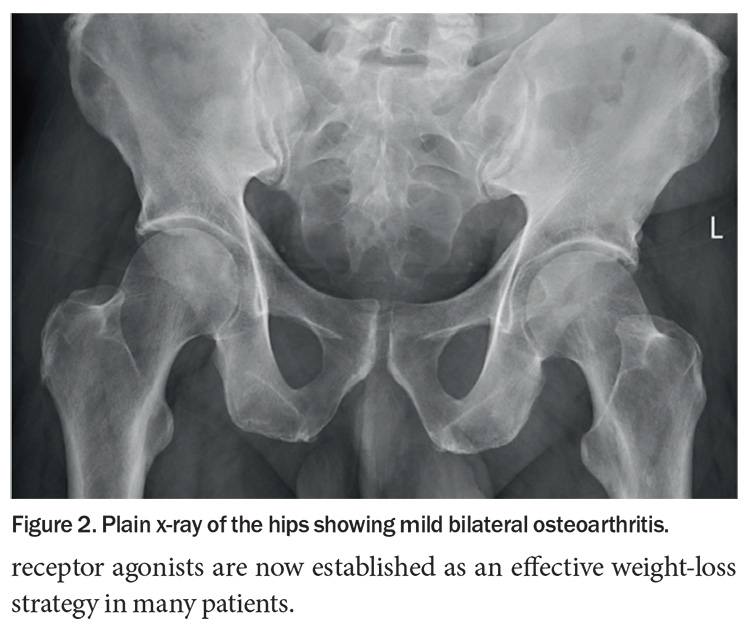
The older the patient with groin pain and the more restricted the range of hip motion, particularly internal rotation, the greater the likelihood of hip osteoarthritis and therefore the greater the diagnostic yield of plain x-ray. If pain localisation is vague and onset gradual, hip osteoarthritis may be diagnosed on plain x-ray alone (Figure 2), without the need for further imaging such as MRI.
MRI scan
If imaging is indicated, MRI is now the gold-standard investigation for people with groin pain because it provides excellent assessment of muscles, tendons, bones and joints. MRI also avoids ionising radiation, so any potential harm is more likely to result from inappropriate subsequent management than from the investigation itself.
Other than in very young patients, MRI will frequently demonstrate some abnormality, and the challenge lies in determining the clinical relevance of findings and avoiding the attribution of symptoms to pathology that may lead to unnecessary intervention.41,42 In this respect, groin pain resembles back pain, where there is concern that MRI may contribute to cascades of medical treatment that do not necessarily improve patient outcomes.4
Nearby structures are included within the imaging field; therefore, MRI may occasionally detect valuable incidental findings such as nonmusculoskeletal malignancy. However, incidental benign findings, particularly in women (e.g. ovarian cysts and fibroids), are also common.
MRI remains particularly valuable in:
- high-level athletes
- workers’ compensation cases
- patients with red flags for severe pathology, such as weight loss or a history of malignancy.
Potential benefits of MRI include: - exclusion of serious pathology, including malignancy, osteonecrosis and femoral neck stress fracture
- assisting with prognosis and estimating timeframe for return to activity, particularly in muscle strains and stress fractures.43,44
Imaging is generally less useful in determining prognosis for early degenerative joint disease and tendinopathy.
Dynamic ultrasound
If inguinal or other hernia forms part of the differential diagnosis, ultrasound is useful because it allows for comparison of resting and straining appearances, which MRI cannot provide.
Macroscopic inguinal hernia more commonly presents with an intermittent lump than pain, and surgical repair is generally recommended because of the risk of bowel obstruction.
The so-called sportsman’s hernia is a prehernia lesion characterised by weakness of the posterior inguinal wall or widening of the superficial inguinal ring and is associated with chronic groin pain. Despite variable terminology and definitions, conservative treatment is generally recommended initially.45,46 Surgical repair, performed either laparoscopically or via an open approach, remains a second-line option but lacks a strong evidence base.38 Unlike macroscopic hernia, these cases should not be assumed to inevitably require surgery.
Conclusion
Although the groin and hip region has considerable diagnostic complexity, there is increasing appreciation, similar to back pain, that much of this complexity may not alter management in many patients. In the majority of community patients, the most appropriate baseline treatment is load management. This generally involves reducing, but not eliminating, total groin load while pain levels are high, followed by gradual reloading as symptoms improve.
Managing load can be challenging because it may arise from occupational, household and leisure activities. Strengthening exercises prescribed by therapists also contribute to loading and are often beneficial, although they may occasionally contribute to overload.
Investigations such as x-ray, ultrasound and MRI are rarely required as first-line investigations but should be considered when symptoms fail to improve with initial unloading and conservative management. PMT
COMPETING INTERESTS: None.
References
1. Weir A, Brukner P, Delahunt E, et al. Doha agreement meeting on terminology and definitions in groin pain in athletes. Br J Sports Med 2015; 49: 768-774.
2. Bigos S, Davis G. Scientific application of sports medicine principles for acute low back problems. J Orthop Sports Phys Ther 1996; 24: 192-207.
3. Foster NE, Anema JR, Cherkin D, et al. Prevention and treatment of low back pain: evidence, challenges, and promising directions. Lancet 2018; 391: 2368-2383.
4. Hartvigsen J, Hancock MJ, Kongsted A, et al. What low back pain is and why we need to pay attention. Lancet 2018; 391: 2356-2367.
5. Orchard JW. Prescribing and dosing exercise in primary care. Aust J Gen Pract 2020; 49(4): 182-186.
6. Bennell KL, Bayram C, Harrison C, et al. Trends in management of hip and knee osteoarthritis in general practice in Australia over an 11-year window: a nationwide cross-sectional survey. Lancet Reg Health West Pac 2021; 12: 100187.
7. Kline W. Exposed: The Hidden History of the Pelvic Exam. 1. Pelvic Violence: Nassar and the National Nightmare. Boston: Polity; 2024.
8. Holmich P, Uhrskou P, Ulnits L, et al. Effectiveness of active physical training as treatment for long-standing adductor-related groin pain in athletes: randomised trial. Lancet 1999; 353: 439-43.
9. Hölmich P, Larsen K, Krogsgaard K, Gluud C. Exercise program for prevention of groin pain in football players: a cluster-randomized trial. Scand J Med Sci Sports 2010; 20: 814-821.
10. Blanch P, Gabbett TJ. Has the athlete trained enough to return to play safely? The acute:chronic workload ratio permits clinicians to quantify a player’s risk of subsequent injury. Br J Sports Med 2016; 50: 471-475.
11. Mellor R, Grimaldi A, Wajswelner H, et al. Exercise and load modification versus corticosteroid injection versus ‘wait and see’ for persistent gluteus medius/minimus tendinopathy (the LEAP trial): a protocol for a randomised clinical trial. BMC Musculoskelet Disord 2016; 17: 196.
12. Soligard T, Schwellnus M, Alonso JM, et al. How much is too much? (Part 1) International Olympic Committee consensus statement on load in sport and risk of injury. Br J Sports Med 2016; 50: 1030-1041.
13. Feldman K, Franck C, Schauerte C. Management of a nonathlete with a traumatic groin strain and osteitis pubis using manual therapy and therapeutic exercise: a case report. Physiother Theory Pract 2020; 36: 753-760.
14. Orchard JW. Rock, paper, scissors: Resolving the conflicting results of randomized trials involving corticosteroid, platelet rich plasma (PRP) and placebo injections. JSAMS Plus 2025; 5: 100081.
15. Byrne CA, Bowden DJ, Alkhayat A, et al. Sports-related groin pain secondary to symphysis pubis disorders: correlation between MRI findings and outcome after fluoroscopy-guided injection of steroid and local anesthetic. AJR Am J Roentgenol 2017; 209: 380-388.
16. Dorleijn DMJ, Luijsterburg PAJ, Reijman M, et al. Intramuscular glucocorticoid injection versus placebo injection in hip osteoarthritis: a 12-week blinded randomised controlled trial. Ann Rheum Dis 2018; 77: 875-882.
17. Klaassen AD, Jorritsma W, Willigenburg NW, et al. Effectiveness of total hip arthroplasty versus non-surgery on patient-reported hip function at 3 months: a target trial emulation study of patients with osteoarthritis. Acta Orthop 2025;
96: 310-316.
18. Frydendal T, Christensen R, Mechlenburg I, et al. Total hip replacement or resistance training for severe hip osteoarthritis. N Engl J Med 2024; 391: 1610-1620.
19. Alagha MA, Cobb JP, Liddle AD, et al. Prediction of quality-of-life improvement after total hip arthroplasty : a simplified and internally validated model based on 82,526 total hip arthroplasties from the Swedish Arthroplasty Register. Bone Jt Open 2025; 6: 1504-1514.
20. Hoskins W, Bingham R, Corfield S, et al. Do the revision rates of arthroplasty surgeons correlate with postoperative patient-reported outcome measure scores?
A Study From the Australian Orthopaedic Association National Joint Replacement Registry. Clin Orthop Relat Res 2024; 482: 98-112.
21. Orchard JW, Tutt LE, Hines A, Orchard JJ. Associations between common hip and knee osteoarthritis treatments and all-cause mortality. Healthcare (Basel) 2025; 13(17): 2229.
22. Elliott J, Wu Y, Steinbrück A, Grimberg AW. Survivorship and risk factors for revision after total hip arthroplasty in patients 30 years and younger: a cohort study from the German arthroplasty register. Acta Orthop 2026; 97: 14-20.
23. Aşkın Turan S, Mazman S, Yalçın Ç, et al. Multifactorial determinants of pulsed radiofrequency treatment outcomes in meralgia paresthetica: a focus on obesity, comorbidities, and technical variables. Neurol India 2025; 73: 1033-1040.
24. Zhao Y, Wang J, Zhao B, Zhang Y. The impact of high BMI on the global burden
of osteoarthritis from 1990 to 2021 and future projections. Front Med 2025;
12: 1561750.
25. Spurzem GJ, Broderick RC, Ruiz-Cota P, et al. The new bridge to hernia surgery: achieving preoperative weight optimization with GLP-1 receptor agonists for abdominal wall hernia repair. Surg Endosc 2025; 39: 5296-5302.
26. Catenacci VA, Odgen L, Phelan S, et al. Dietary habits and weight maintenance success in high versus low exercisers in the National Weight Control Registry. J Phys Act Health 2014; 11: 1540-1548.
27. Bliddal H, Bays H, Czernichow S, et al. Once-weekly semaglutide in persons with obesity and knee osteoarthritis. N Engl J Med 2024; 391: 1573-1583.
28. Zaffar H, Imran MA, Hussain S, Rushd F. Impact of glucagon-like peptide-1 receptor agonists on hip arthroplasty outcomes: a systematic review and meta-Analysis. Cureus 2025; 17(11): e96279.
29. Yang F, Zhou L, Zhang J, et al. Association of semaglutide use with outcomes in chronic plantar heel pain: a prospective observational cohort and a pilot interventional study. Int J Surg 2025; 111: 9333-9341.
30. Hackney R. The sports hernia. Sports Med Arthroscopy Rev 1997; 5: 320-327.
31. Malycha P, Lovell G. Inguinal surgery in athletes with chronic groin pain: the ‘sportsman’s’ hernia. Aust N Z J Surg 1992; 62: 123-125.
32. Akermark C, Johansson C. Tenotomy of the adductor longus tendon in the treatment of chronic groin pain in athletes. Am J Sports Med 1992; 20: 640-643.
33. Alter TD, Wichman DM, Knapik DM, et al. Iliopsoas bursitis managed with endoscopic bursectomy and lesser trochanter decompression: a case report. JBJS Case Connect 2021; 11(4).
34. Innocenti M, Nistri L, Biondi M, et al. Hip arthrosis and surgical intervention: what and when? Clin Cases Miner Bone Metab 2013; 10: 41-46.
35. Creuzé A, Fok-Cheong T, Weir A, et al. Novel use of botulinum toxin in long-standing adductor-related groin pain: a case series. Clin J Sport Med 2022; 32: 567-573.
36. Lieberman JR, Engstrom SM, Solovyova O, et al. Is intra-articular hyaluronic acid effective in treating osteoarthritis of the hip joint? J Arthroplasty 2015; 30: 507-511.
37. Ramadanov N, Lettner J, Voss M, et al. Conservative treatment versus hip arthroscopy in patients with femoroacetabular impingement : a multilevel meta-analysis of randomized controlled trials. Bone Jt Open 2025; 6: 480-498.
38. Hatem M, Martin RL, Bharam S. Surgical outcomes of inguinal-, pubic-, and adductor-related chronic pain in athletes: a systematic review based on surgical technique. Orthop J Sports Med 2021; 9(9): 23259671211023116.
39. Orchard JW, Jomaa MC, Orchard JJ, et al. Fifteen-week window for recurrent muscle strains in football: a prospective cohort of 3600 muscle strains over 23 years in professional Australian rules football. Br J Sports Med 2020; 54: 1103-1107.
40. Ekstrand J, Hagglund M, Walden M. Epidemiology of muscle injuries in professional football (soccer). Am J Sports Med 2011; 39: 1226-1232.
41. Jones H, Chang IJ, Chen D, et al. Prevalence of asymptomatic acetabular labrum abnormalities in the active pediatric population. J Pediatr Orthop 2025; 45: e468-e472.
42. Nielsen MF, Hölmich P, Branci S, et al. Pubic-related radiographic findings in male football players with long-standing groin pain, and asymptomatic controls - are they clinically relevant? Scand J Med Sci Sports 2025; 35(5): e70068.
43. Faiella E, Pileri M, D’Andrea V, et al. MRI features of acute muscle injuries in professional soccer players: a systematic review of prognostic associations with return to play. AJR Am J Roentgenol 2026; 226(3): e2533710.
44. Hoenig T, Tenforde AS, Strahl A, et al. Does magnetic resonance imaging grading correlate with return to sports after bone stress injuries? A systematic review and meta-analysis. Am J Sports Med 2022; 50: 834-844.
45. Orchard J, Read J, Neophyton J, Garlick D. Ultrasound findings of inguinal canal posterior wall deficiency associated with groin pain in footballers. Br J Sports Med 1998; 32: 134-139.
46. Gilmore O. Gilmore’s groin. Sportsmed Soft Tissue Trauma 1992; 3(3).
Single article purchases are temporarily unavailable due to site maintenance.
If you would like to purchase an article during this time, please email us at [email protected] with the article details and we'll assist you directly. We'll also let you know when online purchasing is available again.
Thank you for your patience and understanding.