
Preventive therapies for migraine

Migraine is a common and disabling condition. Preventive therapies can help reduce acute attacks, reliance on acute medication and migraine-associated disability. This article highlights considerations regarding initiation and choice of prophylactic agent.
- Migraine is a common and disabling condition, affecting up to 15% of the global population.
- Use of prophylactic therapy can reduce the frequency and severity of migraine.
- Prophylactic therapy should be considered if a patient has four or more headache days per month. Patients with unusually disabling attacks, such as prolonged attacks that respond suboptimally to acute treatments or attacks occurring from sleep with severe nausea and vomiting, may also benefit from prophylaxis.
- A wide range of oral prophylactic options is available, which require consideration of comorbidities and side-effect profiles.
- Consider referring the patient to a neurologist if they have failed to respond, or are intolerant, to three oral prophylactic agents.
- New injectable options have higher efficacy but specific criteria must be met to access these on the PBS.
Migraine is an extremely common and disabling condition in the community, which is often poorly managed. The prevalence of migraine is about 15% worldwide, with a two- to threefold higher prevalence in women.1 Migraine is the second leading cause of disability worldwide and the leading cause of disability in women younger than 50 years of age.1
Diagnosis
Migraine is a syndrome of recurrent headaches with specific diagnostic criteria (Box).2 Migraine is further classified based on headache frequency:
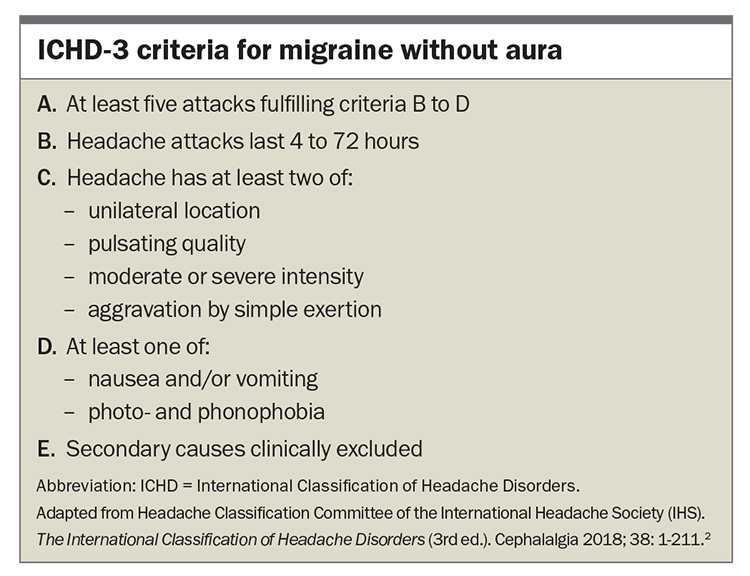
- episodic migraine: up to 14 headache days per month, subdivided into low-frequency episodic migraine (up to seven days) and high-frequency episodic migraine (eight to 14 days).
- chronic migraine: at least 15 headache days per month for more than three months, including at least eight migraine days.
A migraine day is a headache day with at least moderate pain severity and accompanied by sensitivity to light or noise, with or without nausea, or headache responding to a triptan (e.g. rizatriptan, sumatriptan) or an ergotamine derivative acutely. Establishing an accurate diagnosis assists with selecting appropriate therapy.
Treatment
The management of migraine requires an individualised approach. The three key components are avoiding trigger factors (including psychosocial factors), management of acute attacks and prophylaxis if appropriate. This article focuses on practical approaches to migraine prophylaxis.
When to consider prophylaxis
The International Headache Society recommends starting a patient on regular preventive treatment if they have four or more headache days per month.3 The decision is made in conjunction with the patient, considering attack frequency, severity, duration and degree of disability. Patients with unusually disabling attacks, such as prolonged attacks that respond suboptimally to acute treatments or attacks occurring from sleep with severe nausea and vomiting, may benefit from prophylaxis even if attacks occur less than twice a month.
How to assess efficacy of treatment
A 50% or more reduction in headache or migraine days is generally considered efficacious. Maintaining a headache diary helps to reduce recall bias. Although a reduction in migraine headache days is the primary goal of treatment, other potential benefits include a reduced severity of attacks, improved responsiveness to acute medications or decreased vulnerability to triggers.4 Most patients should trial prophylaxis for three months, although they may need to stop earlier because of side effects.
Prophylaxis options for migraine
Traditional oral agents
In Australia, there has been a strong bias, especially among GPs, for the use of pizotifen or propranolol.5 However, these are not always the most appropriate individual choice. The initial choice of agent should consider other comorbidities, including the potential side-effect profile (Table 1). A prophylactic drug should be continued for long enough to assess efficacy, which can take up to three months. Drugs that are ineffective after this time should be discontinued and alternatives considered. Rotating through a few options may be necessary as effectiveness can vary over time.
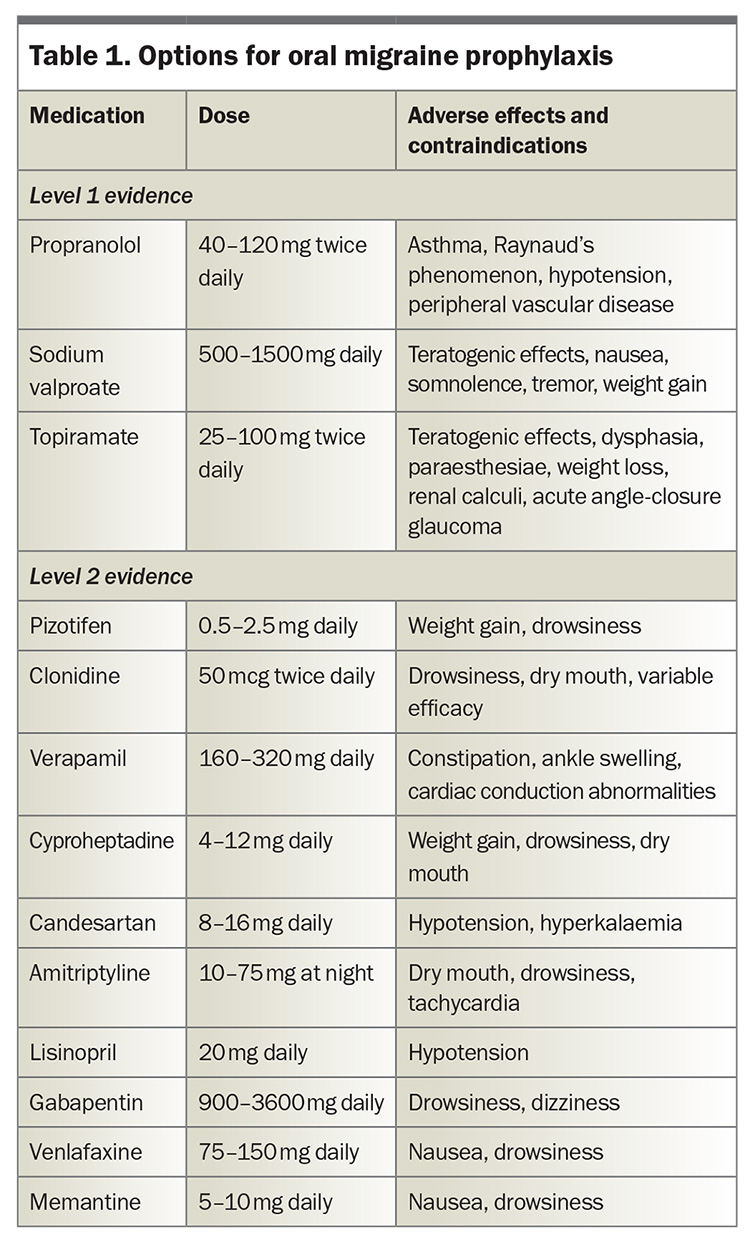
The wide array of oral agents used for migraine prophylaxis mostly arose for other indications such as depression, hypertension or epilepsy. Despite this, there is excellent evidence available for the use of many of these prophylactic agents, as long as they are tolerated.
Anticonvulsants
Anticonvulsants have the strongest evidence for migraine prophylaxis, with topiramate and sodium valproate being the most thoroughly evaluated. A meta-analysis of three trials of sodium valproate, involving 510 patients with dose ranges from 500 to 1500 mg daily, showed an odds ratio of 2.74 (95% confidence interval [CI], 1.48–5.08; p = 0.001) for experiencing a 50% or greater reduction in the frequency of migraines compared with placebo.6 Sodium valproate and topiramate are known teratogens and so should not be used in women of childbearing potential without reliable contraception.7
A meta-analysis of four trials comparing topiramate 100 mg daily with placebo in 828 patients showed an odds ratio of 2.44 (95% CI 1.81–3.28; p<0.0001) for a 50% or greater reduction in migraine frequency. Adverse effects were common, particularly at higher doses, and led to treatment cessation in up to 30% of patients.6 More recently, topiramate was studied in a head-to-head trial with erenumab (one of the calcitonin gene-related peptide [CGRP] antagonists), showing similar efficacy but higher discontinuation in the topiramate group due to adverse events.8 Topiramate can reduce the effectiveness of hormonal contraceptives. Rarer side effects such as renal calculi and glaucoma may require consideration in some patients. The anorexia and weight loss side effects can be of benefit in patients trying to lose weight. To access topiramate on the PBS, the patient must have failed to respond to or have a contraindication to propranolol and pizotifen.
The evidence to support the use of gabapentin in migraine is less strong with one high-quality trial demonstrating an odds ratio of 4.51 (95% CI, 1.51–13.43) for a 50% or more reduction in migraine days.9 Gabapentin may be particularly useful in patients with comorbid neuropathic pain.
Antihypertensives
Propranolol has been well studied, with a Cochrane review showing a relative risk of 1.94 (95% CI, 1.61–2.35; p<0.00001) for a 50% or more reduction in migraine frequency compared with placebo.10 The major adverse effects are fatigue, mood changes and reduced heart rate and blood pressure. Caution should be used in patients with asthma and peripheral vascular disease.
Good-quality, cross-over, placebo-controlled trials have demonstrated the efficacy of candesartan and lisinopril, which are generally well tolerated in patients with migraine.11
Antidepressants
Amitriptyline is often used as a first-line agent for migraine. The available trial data are heterogeneous but all studies show a beneficial effect, with one trial demonstrating an odds ratio of 2.41 (95% CI, 1.07–5.40) for a 50% or more reduction in migraine frequency compared with placebo.12 Dry mouth and drowsiness are commonly reported dose-dependent side effects. Patients experiencing initial insomnia may benefit from a reduction in sleep latency.
Nortriptyline is less well studied than amitriptyline but the anticholinergic side effects tend to be less prominent, making it more tolerable for some patients.
Trials comparing venlafaxine with nortriptyline and amitriptyline found that the efficacy and side-effect profiles of the agents are comparable. No large placebo-controlled trials have been performed. There are some concerns about significant side effects during the withdrawal period.13 Venlafaxine may improve menopausal vasomotor symptoms, making it suitable for perimenopausal women.14
Memantine demonstrated a reduction in monthly migraine days compared with placebo in a single small randomised controlled trial (RCT) and with reasonable tolerability, the main side effects being sedation, nausea and dizziness.15 A network meta-analysis and systematic review of the smaller studies suggest a positive effect, but longer-term studies are needed.16 Memantine is not PBS listed for migraine.
Vitamins and supplements
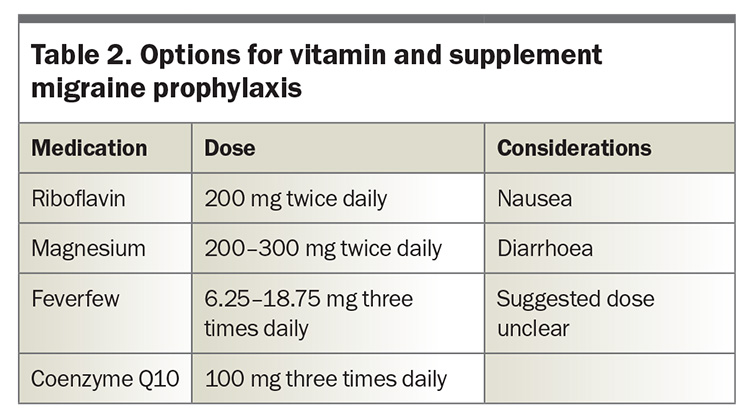
Vitamins and supplements are a useful adjunct or alternatives for patients who are reluctant to take a prescription medication. This may be due to concern regarding side effects of the prescription medication, being able to purchase vitamins and supplements directly or perceiving them as a natural alternative. Evidence of superiority to placebo for reducing migraine frequency has been shown for feverfew, magnesium citrate, riboflavin and coenzyme Q10, although the effect sizes are small (Table 2).17 High-dose vitamin B6, gingko biloba, ginseng, liquorice and ashwagandha are not recommended for migraine. Replacement of other deficiencies is advised.
Advanced prophylactic therapies
Some patients fail to respond adequately to traditional oral prophylactic agents. Others may find them intolerable or have contraindications to multiple agents. If a patient fails at least three oral prophylactic options, referral to a neurologist may be appropriate for consideration of advanced therapies.
Calcitonin gene-related peptide monoclonal antibodies
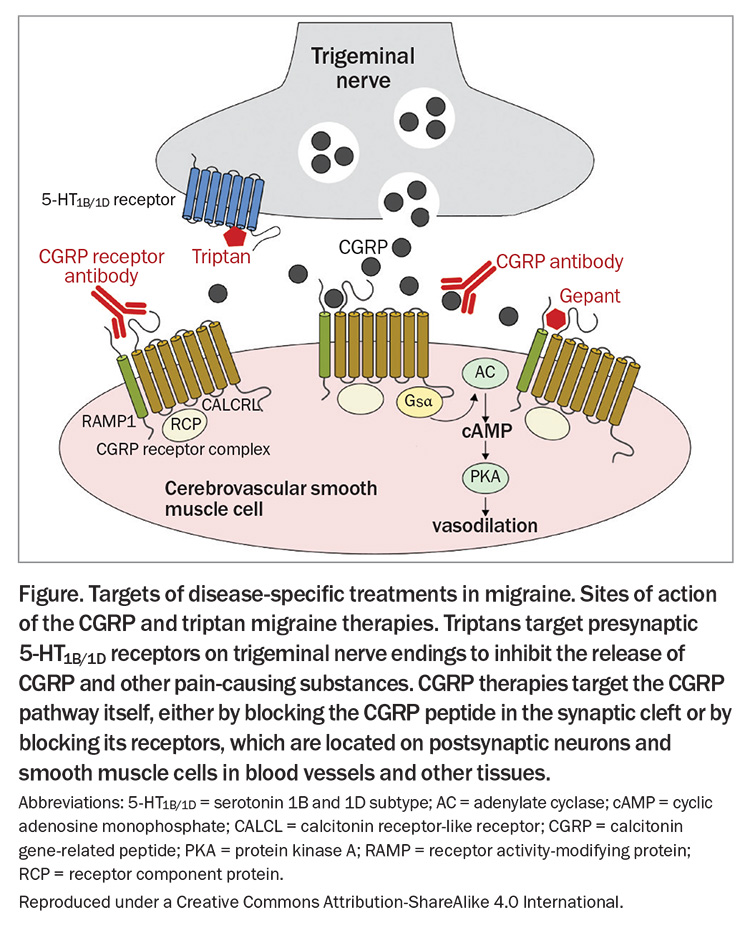
CGRP monoclonal antibodies are the first disease-specific preventive therapies for migraine. CGRP is a neuropeptide that is concentrated in the trigeminovascular system. The CGRP monoclonal antibodies prevent CGRP from binding to its receptor by targeting either the CGRP molecule (fremanezumab, galcanezumab and eptinezumab) or the receptor (erenumab) (Figure).
Fremanezumab and galcanezumab are both administered as four-weekly subcutaneous self-injections and eptinezumab is delivered as a 12-weekly intravenous infusion. Fremanezumab, galcanezumab and eptinezumab have similar long half-lives (31, 27 and 27 days, respectively), although some patients report wearing-off effects in the days before their next dose, which resolves with redosing.
Fremanezumab, galcanezumab and eptinezumab are listed on the PBS for the management of chronic migraine, with fremanezumab also listed for use in high-frequency episodic migraine. These treatments can be initiated and continued on a streamlined authority prescription by a GP in collaboration with a neurologist. The PBS criteria include patients with chronic migraine (and for fremanezumab, high-frequency episodic migraine) who have experienced an inadequate response, intolerance or a contraindication to at least three prophylactic migraine medications. Erenumab is not listed on the PBS, so it remains less accessible. For this reason, the discussion in this article focuses on the PBS-listed treatments.
The sentinel RCTs of the CGRP monoclonal antibody therapies differed in their definitions and methodology, so they should not be directly compared. The trials all demonstrated significant reductions in monthly migraine days, and improvements in secondary endpoints. In the trials, a 50% improvement in monthly migraine days ranged from 27.6 to 32% for fremanezumab, 41 to 53% for galcanezumab and 55 to 57.6% for eptinezumab.18-23
In practice, multiple treatment cycles should be assessed. Despite a rapid separation of the treatment group from the controls, it remains useful to assess response after at least three months of treatment, with further gradual improvements expected in responders over time.23 These therapies usually maintain their efficacy when patients respond.24-26
Oral CGRP antagonists (gepants)
The gepants are small-molecule CGRP antagonists. Rimegepant has efficacy as a prophylactic if used on alternate days but also has evidence of efficacy as an acute treatment.27,28 This makes it an appealing option for patients who rely heavily on acute treatment for their migraine and are at risk of developing medication overuse headache. Rimegepant is approved by the TGA for the acute treatment of migraine in adults and prophylactic treatment of episodic migraine in adults who have at least four migraine attacks per month. Rimegepant is not currently listed on the PBS, so it is a relatively expensive option.
Onabotulinum toxin A
Onabotulinum toxin A is a neurotoxin administered via injection by a trained physician, targeting the sensory nerves of the head and neck. It is PBS subsidised for neurologists to provide the PREEMPT protocol for chronic migraine, provided the patient meets specific eligibility criteria. Patients must have an average of 15 or more headache days per month, with at least eight days of migraine, over a period of at least six months and have an inadequate response, intolerance or a contraindication to at least three prophylactic migraine medications prior to commencement of treatment with onabotulinum toxin A.
The sentinel RCTs showed a reduction of eight to nine headache days per month with significant quality of life improvements.29,30 Subsequent real-world studies have confirmed this efficacy, including ongoing improvement by two years of the treatment.31 Onabotulinum toxin A has good tolerability, a short half-life and minimal drug interactions. Adverse effects include neck pain and ptosis, which are less common with experienced injectors. Any adverse effects are reversible as the pharmacological effects wear off.
Device therapies
The neuromodulation devices currently available in Australia include an external trigeminal nerve stimulation device (Cefaly) and an external vagal nerve stimulator (GammaCore).
The external trigeminal nerve stimulation device was demonstrated in a single, placebo-controlled trial to reduce migraine frequency compared with placebo when used for 20 minutes daily.32 Subsequent placebo-controlled trials demonstrated similar results with minimal side effects. This device is not funded by the PBS but is approved by the TGA and does not require a prescription.
The vagus nerve electrical stimulator is also not funded by the PBS and requires a prescription to access. The evidence for implanted stimulator devices (occipital nerve and vagus nerve) is inconsistent, with significant safety and tolerability concerns.
Individualising preventive therapy
Individualised factors need to be considered when selecting the most appropriate migraine preventive strategy, particularly in specific groups of patients.
Special populations
Menstrual migraine
The higher prevalence of migraine in women reflects the role of hormonal factors in those with menstrual-related migraine. A menstrual migraine attack occurs from two days before until three days after the start of menstruation. These attacks tend to be more severe, longer lasting and less responsive to treatment than non-menstrual migraine. For this reason, clinicians should have a lower threshold for starting prophylaxis in this setting. Evidence for the efficacy of prophylactic agents in this group is limited; however, two studies evaluating the use of CGRP monoclonal antibodies have shown benefit.14 Hormonal manipulation to suppress menstruation is another commonly used strategy, although this is beyond the scope of this article.
Vestibular migraine
Vestibular migraine may be particularly disabling and the diagnostic criteria have only recently been established.2 As such, specific evidence for the management of this condition is limited. Flunarizine, a nonselective antagonist of the slow voltage-dependent calcium channels, is the best studied agent. Two small, randomised, placebo-controlled trials demonstrated reduced vertiginous symptoms in patients with vestibular migraine, but reductions in headache were not significant.33,34 Depression and weight gain can be significant side effects. Flunarizine is not widely available in Australia, but can be accessed through the Special Access Scheme. Propranolol, topiramate, venlafaxine and sodium valproate each have some evidence to support efficacy for vertiginous symptoms. Pizotifen is often used in this patient group despite a lack of trial data, and was the most commonly prescribed prophylactic in patients presenting to the Eye and Ear hospital in Melbourne with vestibular migraine (30% of patients).35 In clinical practice, the usual principles for selection of a migraine preventive apply to this group.
Age-specific consideration
Most clinical trials exclude patients younger than 18 years of age and older than 65 years of age, so there are limited data in these groups. This has global ramifications for subsidised access to many medications in paediatric and adolescent patients. In older people, comorbidities, polypharmacy and safety should be carefully considered when selecting from the preventives available for adults.
Pregnancy and lactation
Pregnant and lactating patients are excluded from clinical trials; therefore, the safety data for preventive therapies remain limited.
Conclusion
A wide range of oral preventive options is available to GPs for patients with migraine. Injectable therapies, including onabotulinum toxin A and the disease-targeting CGRP antagonist treatments, are available for patients who are co-managed with a neurologist. Individualising preventive therapy to optimise safety, tolerability, longer-term adherence and efficacy can help to improve patient outcomes. Preventive medications can reduce the frequency and severity of migraine, leading to improvements in migraine impact, functioning and quality of life. PMT
COMPETING INTERESTS: Dr Stark has received speaker fees from and participates on the advisory board for Abbvie. Dr Jenkins has received payment for lectures from Allergan/Abbvie, Eli Lilly, Novartis, Pfizer and Teva and support from Pfizer for attending meetings. She is also the Immediate Past President of the Australian and New Zealand Headache Society; Member of the leadership, education and ethics subcommittees of the International Headache Society; and Associate Editor of Cephalalgia.
References
1. Steiner TJ, Stovner LJ, Jensen R, et al. Global epidemiology of migraine and its implications for public health and health policy. Nat Rev Neurol 2023; 19: 109-117.
2. Headache Classification Committee of the International Headache Society (IHS). The International Classification of Headache Disorders (3rd ed.). Cephalalgia 2018; 38: p. 1-211.
3. Puledda F, Sacco S, Diener H, et al. International Headache Society global practice recommendations for preventive pharmacological treatment of migraine. Cephalalgia 2024; 44: 1-31.
4. Ziegler DK, Hurwitz A, Preskorn S, et al. Propranolol and amitriptyline in prophylaxis of migraine: pharmacokinetic and therapeutic effects. Arch Neurol 1993; 50: 825-830.
5. Stark RJ, Valenti L, Miller GC. Management of migraine in Australian general practice. Med J Aust 2007; 187: 142-146.
6. Pringsheim T, Davenport J, Becker W. Prophylaxis of migraine headache. CMAJ 2010; 182: 269-276.
7. Wyszynski DF, Nambisan M, Surve T, et al. Increased rate of major malformations in offspring exposed to valproate during pregnancy. Neurology 2005; 64: 961-965.
8. Reuter U, Ehrlich M, Gendolla A, et al. Erenumab versus topiramate for the prevention of migraine: a randomised, double-blind, active-controlled phase 4 trial. Cephalalgia 2022; 42: 108-118.
9. Mathew NT, Rapoport A, Saper J, et al. Efficacy of gabapentin in migraine prophylaxis. Headache 2001; 41: 119-128.
10. Linde K, Rossnagel K. Propranolol for migraine prophylaxis. Cochrane Database Syst Rev 2004; (2): CD003225.
11. Carcel C, Haghdoost F, Shen J, et al. The effect of blood pressure lowering medications on the prevention of episodic migraine: a systematic review and meta-analysis. Cephalalgia 2023; 43: 3331024231183166.
12. Couch JR, Hassanein RS. Amitriptyline in migraine prophylaxis. Arch Neurol 1979; 36: 695-699.
13. Burch R. Preventive migraine treatment. Continuum (Minneap Minn) 2021; 27: 613-632.
14. Ghadiri-Sani M. Migraine in women: a review. Curr Opin Neurol 2025; 38: 271-276.
15. Noruzzadeh R, Modabbernia A, Aghamollaii V, et al. Memantine for prophylactic treatment of migraine without aura: a randomized double-blind placebo-controlled study. Headache 2016; 56: 95-103.
16. Li G, Qu B, Zhang L, et al. Role of memantine in adult migraine: a systematic review and network meta-analysis to compare memantine with existing migraine preventive medications. Front Pharmacol 2024; 15: 1496621.
17. Okoli GN, Rabbani R, Kashani HH, et al. Vitamins and minerals for migraine prophylaxis: a systematic review and meta-analysis. Can J Neurol Sci 2019; 46: 224-233.
18. Detke HC, Goadsby PJ, Wang S, et al. Galcanezumab in chronic migraine: the randomized, double-blind, placebo-controlled REGAIN study. Neurology 2018; 91: e2211-e2221.
19. Mulleners WM, Kim BK, Láinez MJA, et al. Safety and efficacy of galcanezumab in patients for whom previous migraine preventive medication from two to four categories had failed (CONQUER): a multicentre, randomised, double-blind, placebo-controlled, phase 3b trial. Lancet Neurol 2020; 19: 814-825.
20. Silberstein SD, Dodick DW, Bigal ME, et al. Fremanezumab for the preventive treatment of chronic migraine. N Engl J Med 2017; 377: 2113-2122.
21. Bigal ME, Dodick DW, Rapoport AM, et al. Safety, tolerability, and efficacy of TEV-48125 for preventive treatment of high-frequency episodic migraine: a multicentre, randomised, double-blind, placebo-controlled, phase 2b study. Lancet Neurol 2015; 14: 1081-1090.
22. Lipton RB, Goadsby PJ, Smith J, et al. Efficacy and safety of eptinezumab in patients with chronic migraine: PROMISE-2. Neurology 2020; 94: e1365-e1377.
23. Dodick DW, Lipton RB, Silberstein S, et al. Eptinezumab for prevention of chronic migraine: a randomized phase 2b clinical trial. Cephalalgia 2019; 39: 1075-1085.
24. Vernieri F, Brunelli N, Messina R, et al. Discontinuing monoclonal antibodies targeting the CGRP pathway after one-year treatment: an observational longitudinal cohort study. J Headache Pain 2021; 22: 154.
25. Ashina M, Goadsby PJ, Reuter U, et al. Long-term efficacy and safety of erenumab in migraine prevention: results from a 5-year, open-label treatment phase of a randomized clinical trial. Eur J Neurol 2021; 28: 1716-1725.
26. Pozo-Rosich P, Detke HC, Wang S, et al. Long-term treatment with galcanezumab in patients with chronic migraine: results from the open-label extension of the REGAIN study. Curr Med Res Opin 2022; 38: 731-742.
27 Croop R, Lipton RB, Kudrow D, et al. Oral rimegepant for preventive treatment of migraine: a phase 2/3, randomised, double-blind, placebo-controlled trial. Lancet 2021; 397: 51-60. Erratum in: Lancet 2024 Jun 15; 403: 2596.
28 Croop R, Goadsby PJ, Stock DA, et al. Efficacy, safety, and tolerability of rimegepant orally disintegrating tablet for the acute treatment of migraine: a randomised, phase 3, double-blind, placebo-controlled trial. Lancet. 2019 Aug 31; 394: 737-745.
29. Aurora SK, Dodick DW, Turkel CC, et al. Onabotulinumtoxin A for treatment of chronic migraine: results from the double-blind, randomized, placebo-controlled phase of the PREEMPT 1 trial. Cephalalgia 2010; 30: 793-803.
30. Diener HC, Dodick DW, Aurora SK, et al. Onabotulinumtoxin A for treatment of chronic migraine: results from the double-blind, randomized, placebo-controlled phase of the PREEMPT 2 trial. Cephalalgia 2010; 30: 804-814.
31. Stark C, Stark R, Limberg N, et al. Real-world effectiveness of onabotulinumtoxin A treatment for the prevention of headaches in adults with chronic migraine in Australia: a retrospective study. J Headache Pain 2019; 20: 81.
32. Schoenen J, Vandersmissen B, Jeangette S, et al. Prevention of migraine by supraorbital transcutaneous neurostimulation using the Cefaly device (PREMICE): a multi-centre, randomized, sham-controlled trial. J Headache Pain 2013; 14(Suppl 1): p184.
33. Lepcha A, Amalanathan S, Augustine AM, Tyagi AK, Balraj A. Flunarizine in the prophylaxis of migrainous vertigo: a randomized controlled trial. Eur Arch Otorhinolaryngology 2014; 271: 2931-2936.
34. Yuan Q, Liu DL, Yu LS, Zhang QF. Flunarizine in the prophylaxis of vestibular migraine:a randomized controlled trial. J Clin Otorhinolaryngology Head, Neck Surg 2016; 30: 805-810.
35. Power L, Shute W, McOwan B, et al. Clinical characteristics and treatment choice in vestibular migraine. J Clin Neurosci 2018; 52: 50-53.
Single article purchases are temporarily unavailable due to site maintenance.
If you would like to purchase an article during this time, please email us at [email protected] with the article details and we'll assist you directly. We'll also let you know when online purchasing is available again.
Thank you for your patience and understanding.