
Chronic pain in older adults: a multimodal approach for patients with geriatric syndromes
Consensus guidelines consistently recommend a multimodal approach to chronic pain management, emphasising the integration of medical, physical and psychological therapies. Common geriatric syndromes such as frailty, multimorbidity and dementia increase the complexity of management but should not be perceived as barriers to a multimodal approach. They strengthen the rationale for diversified, person-centred pain management.
- Chronic pain is common in older adults and becomes more prevalent with advancing age.
- Musculoskeletal pain is the most common type of pain, predominantly affecting the back, hips, knees, neck and shoulders.
- When the underlying cause of chronic pain cannot be reversed or treated, the recommended strategy is multimodal management incorporating medical, physical and psychological therapies.
- Geriatric syndromes such as frailty, multimorbidity and dementia complicate pain management but do not preclude an individualised, multimodal approach to care.
At least one in five older people in Australia report persistent pain of moderate or severe intensity, with even higher rates in those aged older than 85 years.1 The prevalence of pain in residential care settings has been reported to be as high as 80%.2 The increased prevalence of pain with advancing age is better explained by a greater burden of painful pathology in old age, rather than an indication that pain is an inherent part of the ageing process. The most common pains are of musculoskeletal origin, affecting the back, hips, knees, neck and shoulders.3 Pain is often reported at multiple sites. Other conditions that should be considered include neuropathic pain (e.g. postherpetic neuralgia, lumbar radiculopathies and painful diabetic peripheral neuropathy), fibromyalgia, polymyalgia rheumatica and cancer-related pain.4
Acute and chronic pain require different management approaches. Acute pain is usually a symptom of tissue injury or illness, settling with treatment or healing of the underlying cause. It can be seen as serving a protective or adaptive role.
Chronic pain is defined as pain persisting or recurring for longer than three months, beyond the expected time for healing, where relevant.5 It may be associated with considerable morbidity, including poor self-reported health, increased healthcare utilisation, disability, decreased quality of life, depression, anxiety, cognitive impairment, sleep disturbance and decreased socialisation.6,7 Chronic pain does not respond to treatment in the same manner as acute pain, often persisting even after treatment. In this scenario, the focus shifts to optimisation of function, mood and quality of life rather than eradication of pain.
This article focuses on the management of chronic pain in older adults, especially in the setting of common geriatric syndromes such as frailty, multimorbidity and cognitive impairment. Guidance on the management of specific pain conditions is beyond the scope of this article.
Pain assessment
Inquiry about the presence of pain should occur during the initial assessment in all settings where older people receive care, and then on a regular basis. Some may deny pain but respond positively to related terms such as ‘sore’, ‘hurting’, ‘aching’ and ‘discomfort’. Others may deny pain at rest but endorse pain during physical activity.8
A careful history and examination can help to exclude conditions requiring urgent or specific treatment. The accuracy of the history should be confirmed if there is any concern about cognition. An open-ended question, such as ‘What would you do if you no longer had pain?’, often reveals valuable information regarding the functional impact of pain, mood state and attitudes. Assessing the patient during a short walk may help distinguish the impact of pain from that better explained by comorbid conditions: for example, when activity is limited by dyspnoea rather than pain. This forms part of a Comprehensive Geriatric Assessment.9
The assessment should include a thorough exploration of current and past therapies including prescription medications, over-the-counter medications, physical techniques, psychological therapies, complementary and alternative medicine and traditional approaches. Effective therapies may previously have been trialled but discontinued while the patient continued to seek further pain relief.
Several assessment tools are available to help assess pain (Box). The Numerical Rating Scale is the most widely used instrument to assess pain severity. The patient is asked to rate their pain on a scale from 0 to 10, with 0 indicating ‘no pain’ and 10 indicating ‘the worst pain imaginable’. Patients who have trouble with this scale may find a Verbal Descriptor Scale easier to complete. This involves selecting the word that best describes the severity of pain from a list.
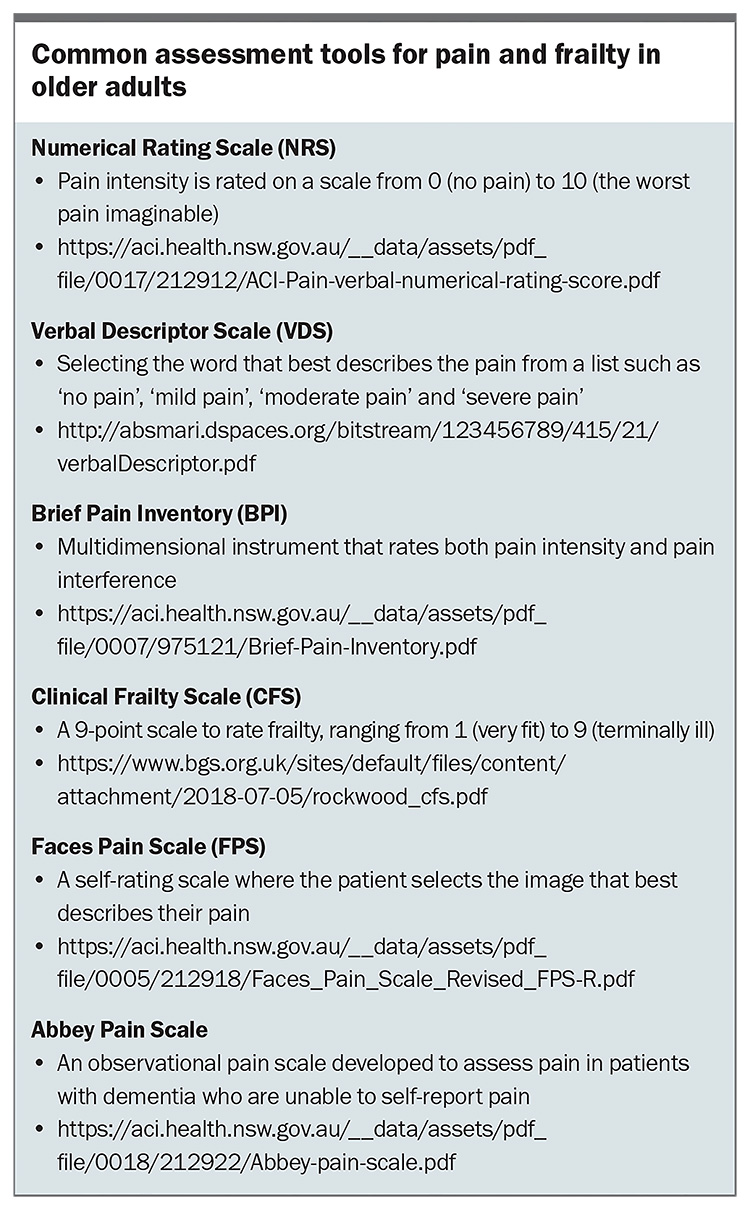
The Brief Pain Inventory is a multidimensional instrument comprising 11 items: four items to evaluate the intensity of pain and seven to evaluate pain interference on general activity, mood, walking, normal work, relations with other people, sleep and enjoyment of life. It only takes a few minutes to complete and has been validated for use in older adults.
Instruments for assessing pain in people living with dementia are discussed later in the article.
Radiological changes are very common in older people, even in those who are asymptomatic.10 The presence of radiological changes does not confirm the presence of pain, nor does the absence of changes confirm that the person is not in pain. Imaging should generally be reserved for cases in which a change in pain is reported, in which red-flag symptoms or signs are identified or when it may alter management.
Special challenges
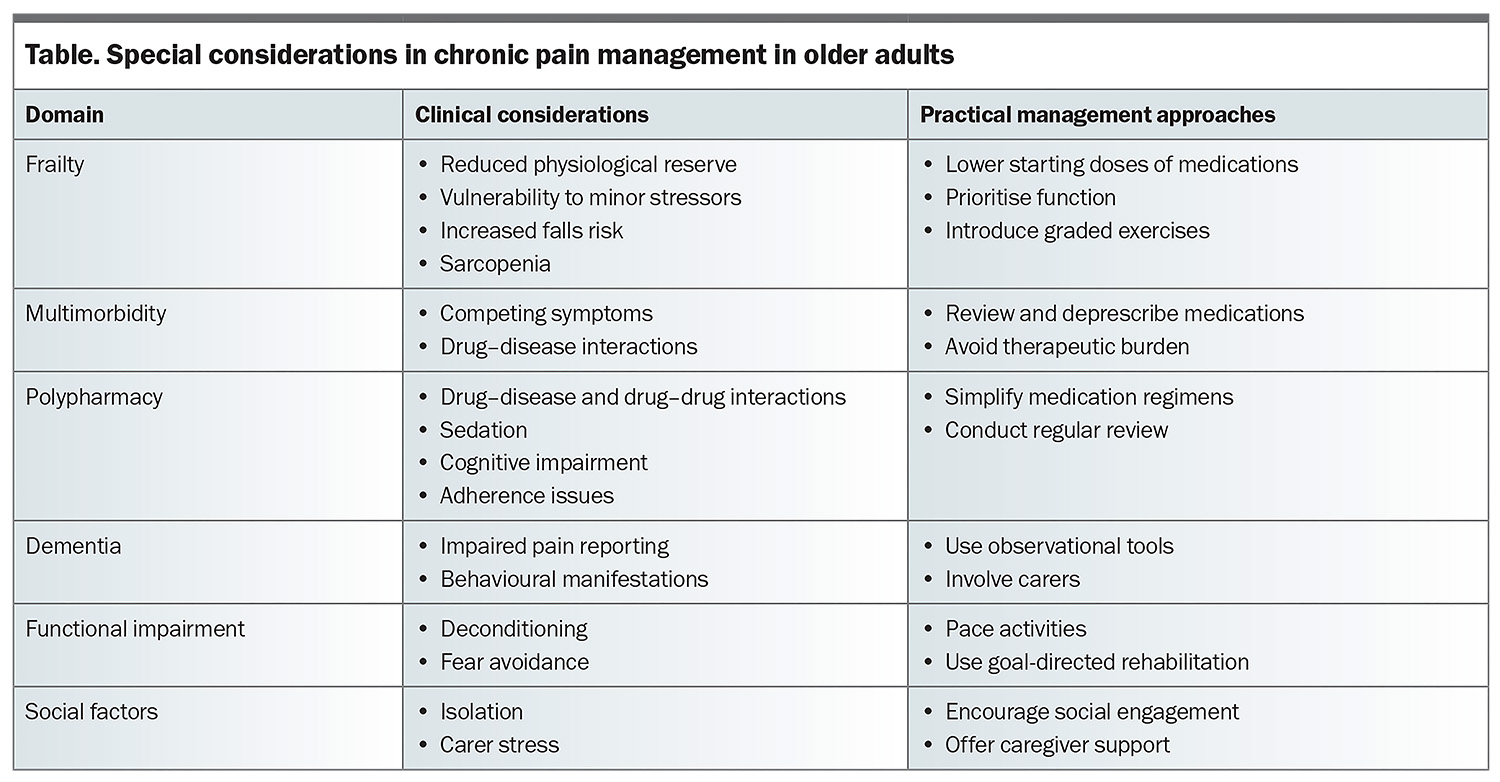
The degree of complexity of managing chronic pain increases when it occurs in the setting of geriatric syndromes such as frailty, multimorbidity or dementia. An overview is provided in the Table.
Frailty
Frailty is commonly recognised and characterised by unintentional weight loss, muscle weakness, easy fatigability, slow gait speed and low physical activity.11 Frailty is a state of vulnerability resulting from decreased physiological reserve across multiple organ systems, making the individual more susceptible to stressors such as a minor illness, injury or medication side effect. Individuals who experience frailty are at increased risk of adverse drug effects, falls, hospitalisation, residential care admission and death. Frailty is not synonymous with disability or multimorbidity, but these conditions may coexist. The use of formal assessment tools may improve consistency and prognostication.
There is a bidirectional relationship between pain and frailty. Individuals with frailty are more likely to report pain. Individuals with chronic pain who do not experience frailty are nearly twice as likely to develop frailty as those without pain.12 The features of chronic pain and frailty may overlap (e.g. slow gait speed and low physical activity).
Rockwood’s Clinical Frailty Scale is a 9-point scale used to rate frailty, ranging from 1 (very fit) to 9 (terminally ill).13 The assessment can be completed rapidly in clinical practice. The degree of frailty is often a better predictor of adverse outcomes than chronological age.
Multimorbidity and polypharmacy
Patients with chronic pain have higher rates of long-term health conditions, such as cardiovascular disease, diabetes, mental health conditions and osteoporosis, compared with those without pain.14 Symptoms arising from chronic pain and comorbid conditions may overlap.
Patients with multimorbidity are likely to use multiple medications. Polypharmacy, defined as the use of five or more medications per day, should trigger a medication review. Polypharmacy may be appropriate or problematic.
In older adults, analgesics should generally be prescribed according to the principle of ‘start low and go slow’. Analgesics should be reviewed on a regular basis, taking into consideration physiological changes associated with ageing. As the person ages, dose reductions should be considered for analgesics including paracetamol, opioids and neuropathic agents such as pregabalin, because of frailty, low body weight, renal impairment or altered pharmacokinetics associated with ageing.
Additional caution is required when managing pain in the setting of multimorbidity and polypharmacy because of the increased risk of drug–drug and drug–disease interactions, adverse drug effects and nonadherence. Examples include the combination of tramadol with a selective serotonin reuptake inhibitor increasing the risk of serotonin syndrome, NSAIDs worsening heart failure or renal function and tricyclic antidepressants worsening cognition or heart disease.
Assessment of treatment response should not only focus on pain intensity but also take into consideration the impact on function and other health problems. Analgesics that have not been effective should be deprescribed.
Dementia
Although pain and dementia often coexist, pain is not a symptom of dementia. Their coexistence reflects the high prevalence of each condition in old age. Impairments in memory and executive function and altered emotional regulation may limit the ability of people with dementia to interpret, communicate and cope with pain.
In its early stages, people living with dementia may still be able to provide a reliable history and complete a self-report pain scale, such as the Numerical Rating Scale, Verbal Descriptor Scale or Brief Pain Inventory. There is no consensus on the stage of dementia that a self-report pain scale becomes unreliable, but some studies have suggested this may occur when the Mini Mental State Examination score falls below 18/30.15 The ability to complete a self-report pain scale does not mean that the score is reliable. Conversely, an inability to self-report pain does not mean that the person is not in pain, or in need of appropriate treatment.16
As dementia progresses the ability to self-report pain declines and is eventually lost. This needs to be assessed on a case-by-case basis. Patients may still be able to say whether they have pain and the location of pain, but they may be unable to provide much more information. Valuable insights may be obtained from a spouse or carer. Clues about the presence of pain in people who are unable to self-report include protecting or rubbing an affected area, abnormal vocalisations (e.g. moaning), changes in behaviours and reluctance to participate in usual activities.
The Faces Pain Scale comprises six faces representing various degrees of distress, extending from ‘no pain’ to ‘worst pain’. For this self-report scale, the patient is instructed to select the image that best aligns with their pain (available at: https://aci.health.nsw.gov.au/chronic-pain/health-professionals/assessment). It is not an observational scale to be completed by an observer.
Observational pain scales have been developed to assess pain in patients with dementia who are unable to self-report pain. They identify changes in vocalisation, facial expression, body language, behaviours and physical features. In Australia, the most widely used instrument is the Abbey Pain Scale, which is endorsed by the Australian Pain Society.17
Automated assessment of facial expression of pain using artificial intelligence has been introduced in some Australian residential care settings.18 Further evaluation of this technology is required.
Defining goals of treatment
When pain cannot be eradicated, the focus shifts from pain elimination to optimisation of function, mood and quality of life despite ongoing pain. This shift in focus is especially relevant for patients who are over-reliant on analgesic medications, and those who limit physical activity in the fear that it may aggravate their pain.
Unrealistic goals are common and often counterproductive. When the primary goal is complete elimination of pain, analgesics may be escalated beyond safe limits, increasing the risk of adverse effects, including dependence. Activity avoidance to control pain is maladaptive. It may result in physical deconditioning and worsening of pain and function, with an increased reliance on medications.
A treatment plan should be developed, working towards realistic person-centred goals prioritising the individual’s needs, preferences and values. It involves integrating medical management, physical rehabilitation, psychological support and social engagement aiming to optimise function, mood and quality of life.
Management
Principles of management
Consensus guidelines for the management of chronic pain in all age groups recommend a multimodal approach targeting medical, physical, psychological and social factors.19 Age-related syndromes such as frailty, multimorbidity and dementia add to the complexity of managing chronic pain, but these should not be considered insurmountable barriers to adopting a multimodal approach, or to justify a predominantly pharmacological approach.
In clinical practice, there is often an over-reliance on pharmacological approaches. The evidence to support pharmacotherapies in the older population is sparse. Older participants, especially those with geriatric syndromes, are typically excluded from therapeutic trials. The efficacy of analgesics for the management of chronic pain is modest, often with limited long-term benefits. A medication that has been demonstrated to be effective in younger individuals is likely to be effective in older adults, although tolerability and pharmacokinetic profiles may differ substantially, and doses may need to be adjusted.
Analgesics should not simply be used to reduce the intensity of chronic pain; their role is also to enable the patient to maintain or improve function and social engagement. If analgesics have not been effective in the past, then persisting with the same approach is unlikely to result in a different outcome in the future. Nonpharmacological therapies should be introduced. The combined use of pharmacological and nonpharmacological therapies is often more effective than when either therapy is used alone.
Comprehensive Geriatric Assessment may be used to select appropriate combinations of pharmacological and nonpharmacological therapies, balancing the risks and benefits of each treatment option, and in supporting shared decision-making with the patient and carers.9,20 It may also help identify other treatable conditions that are amenable to intervention that may contribute to improved function and quality of life apart from pain.8
Nonpharmacological therapies
‘Nonpharmacological therapies’ is an umbrella term for a vast range of physical, psychological, complementary and alternative medicines. Nonpharmacological therapies need to be tailored, taking into consideration the patient’s functional abilities, cognition, comorbidities and goals. Mind–body programs, such as yoga, tai chi, qigong and related programs, may be beneficial in other domains apart from pain, such as physical function, falls prevention, cognition and mood.21 Physical exercise programs are effective in older adults with and without frailty, with greater relative improvement in function observed in those most impaired at the outset.22 Many of the nonpharmacological techniques used for pain management are also appropriate for the management of frailty and cognitive impairment.
There is often insufficient evidence to advocate for one specific therapy over another, but some general comments can be made.
- Education plays a central role, helping the patient to understand the nature of pain and rationale for a multimodal approach, identify goals, set plans, and identify and address barriers.
- The patient should play an active role in their pain management.
- Patient preference plays an important role in the selection of therapy. This may increase adherence.
- The patient should be encouraged to persist with a treatment for several weeks before deciding about its efficacy.
- The opportunity to wean analgesics may occur when nonpharmacological treatments take effect.
Physical therapies
Active physical therapies should take priority over passive therapies. Passive therapies such as massage, thermal packs and acupuncture may provide welcome pain relief, but the effect tends to be short-lived, requiring ongoing treatment. Temporary pain relief does, however, provide an opportunity to facilitate participation in physical activity and rehabilitation.
Active therapies are preferred. These include various mind–body programs working towards functional goals, graded exercises, activity pacing and stress reduction.23 The most effective approaches are those that can be done when a therapist is not in attendance. Adherence to physical activity programs is more likely to occur when they are built into a daily routine and are purposeful.
Walking is an excellent example of a physical therapy. It is accessible, inexpensive and can be performed without a therapist in attendance. Advice may be sought regarding a gait aid or safety. Patients should be encouraged to walk for 20 to 30 minutes per day, tailored to functional capacity, which may comprise a few short walks. Walking with a companion is likely to be more enjoyable, increasing adherence and safety, especially in the setting of dementia. Walking for a purpose (e.g. walking to the shops, to play bingo or to visit a friend) may enhance mood and quality of life.
Water-based therapies are also an option for patients who have difficulty with weight-bearing activities.
Psychological approaches
Psychological therapies form a key part of multimodal pain management. Cognitive behavioural therapy, acceptance and commitment therapy and mindfulness exercises have the strongest evidence base. They are the most effective when delivered by a clinical psychologist, especially for patients with high distress, poor coping, functional limitations, comorbid mental health issues and unrealistic expectations.
Psychological strategies should not be dismissed just because a person has dementia, but they must be modified to accommodate for the cognitive impairments. Language should be kept simple, using short sentences and avoiding jargon. Extra time may be required for processing and for questions. Involvement of a spouse or carer who can assist with implementation of the treatment plan becomes increasingly more important as dementia progresses. This psychological support may also support the carer’s emotional needs.
Providing a written outline of the assessment and recommendations may not only improve adherence but, through the outline being shared, may help engage family members and friends in the treatment program and ensure consistency of the approach. The psychological components include providing education about the nature of pain, goal-setting, pacing, managing insomnia, and encouraging social engagement and other enjoyable activities as distractions from pain. The messages should be kept simple: for example, ‘engage in one activity away from home every day’. An activity such as visiting a neighbour involves many components, such as getting dressed, leaving the home, walking, social engagement and distraction from pain.
Emerging and unproven therapies
Given the challenges of managing pain and limited access to specialist pain services for older people, clinicians and patients may be willing to try unproven or potentially harmful therapies. The increasing use of medicinal cannabinoids for the management of pain is not based on evidence of long-term efficacy and safety or supported by learned pain societies.24-26 A lack of evidence of efficacy does not prove that a therapy is ineffective. The role of the clinician in this regard is to encourage the patient to follow standard treatment approaches prior to trying a new or unproven therapy. The patient should be informed of the potential for and nature of adverse effects. The duration of a therapeutic trial should be negotiated, together with an agreement to discontinue the treatment if the goals are not met. The prescriber should monitor and support the patient.
Referral and specialist care
Referral to a specialist pain physician or geriatrician may be considered when the pain is too complex to be managed at primary care level. Pain specialists play a special role for complex pain conditions that require multimodal approaches or advanced interventions. Geriatricians have a role when pain has an atypical presentation, is intertwined with other geriatric syndromes such as dementia, or is associated with polypharmacy.
Conclusion
Chronic pain management in older adults requires an individualised multimodal approach that accommodates frailty, multimorbidity and cognitive impairment. The GP is often in the best position to develop a multimodal or multidisciplinary pain management plan, integrating the pain problem and comorbidities, together with the patient’s preferences and goals. Referral to a specialist or multidisciplinary pain clinic may be considered on a case-by-case basis. PMT
COMPETING INTERESTS: None.
References
1. Australian Institute for Health and Welfare (AIHW). Chronic pain in Australia. Canberra: AIHW; 2020. Available online at: https://www.aihw.gov.au/reports/chronic-disease/chronic-pain-in-australia/summary (accessed May 2026).
2. Takai Y, Yamamoto-Mitani N, Okamoto Y, Koyama K, Honda A. Literature review of pain prevalence among older residents of nursing homes. Pain Manag Nurs 2010; 11: 209-223.
3. Patel KV, Guralnik JM, Dansie EJ, Turk DC. Prevalence and impact of pain among older adults in the United States: findings from the 2011 National Health and Aging Trends Study. Pain 2013; 154: 2649-2657.
4. Reid MC, Eccleston C, Pillemer K. Management of chronic pain in older adults. BMJ 2015; 350: h532.
5. Treede RD, Rief W, Barke A, et al. Chronic pain as a symptom or a disease: the IASP Classification of Chronic Pain for the International Classification of Diseases (ICD-11). Pain 2019; 160: 19-27.
6. Clauw DJ, Essex MN, Pitman V, Jones KD. Reframing chronic pain as a disease, not a symptom: rationale and implications for pain management. Postgrad Med 2019; 131: 185-198.
7. Patel M, Hasoon J, Diez Tafur R, Lo Bianco G, Abd-Elsayed A. The impact of chronic pain on cognitive function. Brain Sci 2025; 15: 559.
8. Katz B, Alexiou T. The role of Comprehensive Geriatric Assessment in the management of pain in older people. Australian and New Zealand Society for Geriatric Medicine (ANZSGM) Position Statement. Sydney: ANZSGM; 2024. Available online at: https://anzsgm.org/policy-advocacy/position-statements/?fwp_paged=3 (accessed May 2026).
9. Parker SG, McCue P, Phelps K, et al. What is Comprehensive Geriatric Assessment (CGA)? An umbrella review. Age Ageing 2018; 47: 149-155.
10. Brinjikji W, Luetmer PH, Comstock B, et al. Systematic literature review of imaging features of spinal degeneration in asymptomatic populations. AJNR Am J Neuroradiol 2015; 36: 811-816.
11. Fried LP, Tangen CM, Walston J, et al. Frailty in older adults: evidence for a phenotype. J Gerontol 2001; 56A: M146-M156.
12. Lin T, Zhao Y, Xia X, Ge N, Yue J. Association between frailty and chronic pain among older adults: a systematic review and meta-analysis. Eur Geriatr Med 2020; 11: 945-959.
13. Rockwood K, Theou O. Using the clinical frailty scale in allocating scarce health care resources. Can Geriatr J 2020; 23: 210-215.
14. Australian Institute of Health and Welfare (AIHW). Chronic pain in Australia. Canberra: AIHW; 2020. Available online at: https://www.aihw.gov.au/reports/chronic-disease/chronic-pain-in-australia/data (accessed May 2026).
15. Chibnall JT, Tait RC. Pain assessment in cognitively impaired and unimpaired older adults: a comparison of four scales. Pain 2001; 92: 173-186.
16. International Association for the Study of Pain (IASP). IASP announces revised definition of pain. Washington, DC: IASP; 2020. Available online at: https://www.iasp-pain.org/publications/iasp-news/iasp-announces-revised-definition-of-pain/ (accessed May 2026).
17. Abbey J, Piller N, De Bellis A, et al. The Abbey pain scale: a 1-minute numerical indicator for people with end-stage dementia. Int J Palliat Nurs 2004; 10: 6-13.
18. Pu L, Coppierters M, Smalbrugge M, et al. Associations between facial expressions and observational pain in residents with dementia and chronic pain. J Adv Nurs 2024; 80: 3846-3855.
19. Australian Government Department of Health. The National Strategic Action Plan for Pain Management. Canberra: Australian Government; 2021. Available online at: https://www.health.gov.au/resources/publications/the-national-strategic-action-plan-for-pain-management (accessed May 2026).
20. Stuck AE, Iliffe S. Comprehensive geriatric assessment for older adults. BMJ 2011; 343: d6799.
21. Leung DKY, Fong APC, Wong FHC, Liu T, Wong GHY, Lum TYS. Nonpharmacological interventions for chronic pain in older adults: a systematic review and meta-analysis. Gerontologist 2024; 64: gnae010.
22. Flores-Bello C, Correa-Munoz E, Sanchez-Rodriguez MA, Mendoza-Nunez VM. Effect of exercise programs on physical performance in community-dwelling older adults with and without frailty: systematic review and meta-analysis. Geriatrics (Basel) 2024; 9: 8.
23. Hassed C. Mind-body therapies--use in chronic pain management. Aust Fam Physician 2013; 42: 112-117.
24. Fisher E, Moore RA, Fogarty AE, et al. Cannabinoids, cannabis, and cannabis-based medicine for pain management: a systematic review of randomised controlled trials. Pain 2021; 162(Suppl 1): S45-S66.
25. International Association for the Study of Pain (IASP). IASP position statement on the use of cannabinoids to treat pain. Washington, DC: IASP; 2021. Available online at: https://www.iasp-pain.org/publications/iasp-news/iasp-position-statement-on-the-use-of-cannabinoids-to-treat-pain/ (accessed May 2026).
26. Faculty of Pain Medicine, Australian and New Zealand College of Anaesthetists (ANZCA). Statement on “Medicinal Cannabis” with particular reference to its use in the management of patients with chronic noncancer pain. Position statement 10.Melbourne: ANZCA; 2021. Available online at:
https://www.anzca.edu.au/safety-and-advocacy/standards-of-practice/professional-documents?
Single article purchases are temporarily unavailable due to site maintenance.
If you would like to purchase an article during this time, please email us at [email protected] with the article details and we'll assist you directly. We'll also let you know when online purchasing is available again.
Thank you for your patience and understanding.