
Chronic low back pain in a midlife retail worker

Chronic low back pain is one of the most common and costly conditions seen in Australian general practice, with most cases being nonspecific and requiring a nuanced, multifactorial approach. Effective management depends on the early identification of psychosocial risks, careful interpretation of imaging and timely escalation to multidisciplinary care.
- Most chronic low back pain is nonspecific, and imaging findings often do not correlate with symptoms.
- Early recognition of psychosocial factors improves outcomes and reduces the risk of long-term disability.
- Persistent symptoms after six to 12 weeks warrant consideration of multidisciplinary or specialist referral.
- Management should prioritise functional restoration, patient education and co-ordinated care over pain elimination alone.
Case scenario
A 52-year-old woman, who works as a retail assistant, presented with a nine-month history of persistent low back pain, described as a dull ache in the lower lumbar region, occasionally radiating into the right buttock and posterior thigh. The pain was worsened by prolonged standing, lifting stock and bending during shifts, and only partially relieved by NSAIDs and rest. She denied any history of trauma or injury. On examination, her lumbar range of movement was restricted, with pain-limited forward flexion and a slight reduction in lateral flexion, particularly to the right. There was no spinal tenderness on palpation, and neurological examination was unremarkable. Lumbar x-rays showed mild degenerative changes and MRI revealed a small disc bulge at L4 to L5 without nerve root compression. She underwent conservative management (including physiotherapy, ergonomic modifications at work and a lumbar support brace), which yielded limited improvement.
Despite consistent adherence to treatment, the patient reported ongoing functional limitations that were beginning to affect her ability to meet the physical demands of her job. Her past medical history included mild depression and recurrent episodes of musculoskeletal discomfort over the past five years. With symptoms persisting and progress plateauing, the GP considered whether escalation to interventional treatment or referral to a multidisciplinary pain service might be beneficial. How should the GP proceed from here?
Commentary
Chronic low back pain is more than a common issue; it is a major health problem affecting millions worldwide.1 In Australia, low back pain is the most common musculoskeletal presentation in general practice. It affects between one in seven and one in four people in Australia at any time.2 Most cases are classified as nonspecific, meaning no clear cause can be found through physical examination or imaging.1
In addition to the physical effects, chronic low back pain carries a heavy economic burden, leading to decreased productivity, rising healthcare costs and increasing compensation claims. Musculoskeletal pain is one of the leading causes of disability worldwide.3 In Australia, the annual cost of such pain exceeds billions of dollars, mainly because of work absenteeism and health-related loss of function.4 The impacts on both individual health and broader society highlight the urgent need for early treatment and effective management strategies, making musculoskeletal pain a key public health priority.1
When to escalate care
For the case patient, a 52-year-old woman with nonspecific back pain, her care should follow a clear, time-based plan. According to the Australian Commission on Safety and Quality in Health Care’s Low Back Pain Clinical Care Standard, initial assessment and management, including clinical evaluation, psychosocial assessment, patient education and early interventions, should take place within the first two weeks of presentation.5 Progress is then reviewed between two and six weeks, allowing for adjustments to treatment. If symptoms persist or worsen beyond six weeks and up to 12 weeks, referral to multidisciplinary or specialist care is recommended. This is especially important when functional impairment is present, or if there are new concerning signs, such as a change in bowel or bladder habit (especially incontinence), weight loss, fever, new neurological deficits or saddle paraesthesia.
In this case, the patient’s persistent symptoms, limited improvement and difficulty performing her work duties suggest a need for further assessment. At this stage, the GP’s role shifts from direct symptom management to co-ordination of a broader multidisciplinary approach, involving physiotherapy, psychology or pain specialists, based on the patient’s specific needs.
Choosing the right referral pathway
Patient care should be personalised, with referrals to specialists based on each person’s clinical presentation, diagnostic results and personal goals (which should be structured so that they are specific, measurable, achievable, relevant and time-bound [SMART]). Performing an individual assessment helps capture the patient’s unique symptoms and needs. Good care combines clinical knowledge with personal factors so that patients receive the most appropriate treatments instead of following ‘one-size-fits-all’ protocols.6,7
Pain intervention procedures may be considered when conservative measures fail. These can include nerve root injections for persistent radicular pain from disc herniation or foraminal stenosis, and medial branch radiofrequency neurotomy for confirmed facet joint-mediated pain (facet syndrome). However, this patient’s MRI shows no nerve compression and she does not complain of radicular symptoms, making such interventions unlikely to benefit her.
For patients with chronic pain complicated by mood symptoms or disability, multidisciplinary pain programs that combine physical and psychological care offer better support.7 The Australian Pain Society and Pain Australia recommend care models that include physicians, psychologists, physiotherapists and occupational therapists working together.8,9 This ensures treatment plans are consistent with patient goals and promote self-management.5 Studies show that such collaborative approaches reduce pain-related distress, improve coping skills and significantly lower health service use.10
Interpreting imaging and nonspecific findings
Understanding imaging is key in chronic low back pain. Mild wear and small disc bulges seen on x-rays or MRI are common and often unrelated to pain. Imaging studies reveal that the prevalence of disc bulges in pain-free individuals increases with age, from 30% in participants 20 years of age to 84% in those 80 years of age. These findings suggest that many degenerative changes seen on MRI are normal aspects of ageing rather than sources of pain.11
Patient beliefs about imaging results can greatly affect recovery. Misinterpretations can lead to fear avoidance and chronicity. Emphasising that degenerative changes are often a normal part of ageing can help reduce unnecessary worry and interventions.11,12 GPs play a key role in reshaping these expectations, encouraging movement and rehabilitation over rest or repeat scans, and ultimately empowering patients in their recovery journey.
Role of psychosocial factors – ‘yellow flags’
There is increasing evidence that elements of the psychosocial environment are linked to a greater prevalence of experiencing pain, especially chronic pain.13,14 This includes findings from longitudinal studies suggesting that psychosocial factors could serve as risk factors for the future onset of musculoskeletal pain.15,16 Yellow flags, such as fear avoidance, low mood and limited coping skills, predict worse outcomes.17 Most guidelines recommend early screening, involving clinical interviews, physical examination and validated questionnaires such as the Keele Subgroups for Targeted Treatment for Back (STarT) Screening Tool, which stratifies patients with low back pain by their risk of persistent disability to guide targeted treatment decisions. Addressing these concerns promptly and providing therapy and workplace support enhances the chances of recovery.17
Recognising unhelpful beliefs and behaviours, such as catastrophising or fear of movement, enables early behavioural interventions, including cognitive behavioural therapy or graded activity programs. These approaches have demonstrated decreases in disability and utilisation of health services.17
In this patient’s case, integrating psychology into the multidisciplinary team can provide valuable support by offering strategies to address mood disturbances and enhance her engagement in goal-orientated activities, including a gradual return to work. An occupational therapist can collaborate with her employer to assess her work duties and environment, identifying any barriers to her return. This will facilitate a customised, step-by-step plan for a successful return to work through modified duties, thereby promoting sustainable participation.
Practical considerations for GPs
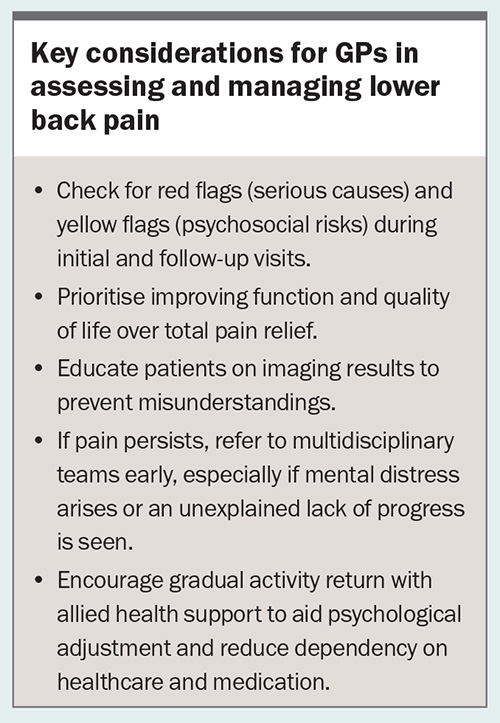
Key considerations for GPs in the ongoing management of chronic low back pain are listed in the Box, and include screening for red and yellow flags, as well as educating patients on how to interpret imaging results.
Summary
Chronic low back pain in adults, especially when associated with mood issues and disability, is best managed through a multidisciplinary team approach that considers all aspects of the pain. Most imaging abnormalities are not strongly linked to symptoms, so careful clinical judgement is essential. Early detection and management of psychosocial factors, along with a focus on restoring function rather than merely reducing pain, are crucial. Timely escalation of care can help prevent long-term disability and improve patient outcomes. By implementing these strategies, GPs and specialists can assist patients in avoiding prolonged work absences and enhancing their quality of life. PMT
COMPETING INTERESTS: None.
References
1. Maher C, Underwood M, Buchbinder R. Non-specific low back pain. Lancet 2017; 389: 736-747.
2. Wheeler LP, Karran EL, Harvie DS. Low back pain: can we mitigate the inadvertent psycho-behavioural harms of spinal imaging? Aust J Gen Pract 2018; 47: 610-613.
3. World Health Organization (WHO). Musculoskeletal health. Geneva: WHO; 2022. Available online at: https://www.who.int/news-room/fact-sheets/detail/musculoskeletal-conditions (accessed November 2025).
4. Safe Work Australia. Innovative study shows that the absence of workplace injury and illness would create a wealthier Australia. Canberra: Safe Work Australia; 2022. Available online at: https://www.safeworkaustralia.gov.au/media-centre/news/innovative-study-shows-absence-workplace-injury-and-illness-would-create-wealthier-australia (accessed November 2025).
5. Australian Commission Safety Quality Health Care (ACSQHC). Low back pain clinical care standard. Sydney: ACSQHC; 2022. Available online at: https://www.safetyandquality.gov.au/standard/clinical-care-standards/low-back-pain-clinical-care-standard (accessed November 2025).
6. Themelis K, Tang NKY. The management of chronic pain: re-centring person-centred care. J Clin Med 2023; 12: 6957.
7. Department of Health, Commonwealth of Australia. National strategic action plan for pain management. Canberra: Department of Health, Commonwealth of Australia: 2021. Available online at: https://www.health.gov.au/resources/publications/the-national-strategic-action-plan-for-pain-management?language=en (accessed November 2025).
8. Australian Pain Society (APS). Position papers. Sydney: APS; 2024. Available online at: https://www.apsoc.org.au/position-papers (accessed November 2025).
9. Pain Australia. Multidisciplinary pain management. Canberra: Pain Australia; 2020. Available online at: https://www.painaustralia.org.au/static/uploads/files/painaust-factsheet4-aug-16-wfyaezqnplrj-wfitritogiwj.pdf (accessed November 2025).
10. Chen N, Katz B. An elderly woman with acute back pain and osteoporosis. Pain Management Today 2018; 5(2): 80-83.
11. Brinjikji W, Luetmer PH, Comstock B, et al. Systematic literature review of imaging features of spinal degeneration in asymptomatic populations. Am J Neuroradiol 2015; 36: 811-816.
12. Nicholas MK, Asghari A, Blyth FM, et al. Self-management intervention for chronic pain in older adults: a randomised controlled trial. Pain 2013; 154: 824-835.
13. Bongers PM, Kremer AM, ter Laak J. Are psychosocial factors, risk factors for symptoms and signs of the shoulder, elbow, or hand/wrist?: a review of the epidemiological literature. Am J Ind Med 2002; 41: 315-342.
14. Hoogendoorn WE, Van Poppel MNM, Bongers PM, Koes BW, Bouter LM. Systematic review of psychosocial factors at work and private life as risk factors for back pain. Spine 2000; 25: 2114-2125.
15. Nahit ES, Hunt IM, Lunt M, Dunn G, Silman AJ, Macfarlane GJ. Effects of psychosocial and individual psychological factors on the onset of musculoskeletal pain: common and site-specific effects. Ann Rheum Dis 2003; 62: 755-760.
16. Hartvigsen J, Lings S, Leboeuf-Yde C, Bakketeig L. Psychosocial factors at work in relation to low back pain and consequences of low back pain; a systematic, critical review of prospective cohort studies. Occup Environ Med 2004; 61: e2.
17. Nicholas MK, Linton SJ, Watson PJ, Main CJ. Early identification and management of psychological risk factors ("yellow flags") in patients with low back pain: a reappraisal. Phys Ther 2011; 91: 737-753.
Single article purchases are temporarily unavailable due to site maintenance.
If you would like to purchase an article during this time, please email us at [email protected] with the article details and we'll assist you directly. We'll also let you know when online purchasing is available again.
Thank you for your patience and understanding.