
Persistent pain: update and potential for development

Editor-in-Chief, Pain Management Today
Pain Specialist at Northern Beaches Pain Management, Sydney, NSW.
Pain
I have the good fortune of taking over as Editor-in-Chief of Pain Management Today from my esteemed colleague and friend, Associate Professor Charles Brooker from Sydney’s Royal North Shore Hospital. Readers should understand that the publishing team is the brains of the outfit. I hope the combination of the publishing team and highly respected authors will provide clinicians with practical reviews and up-to-date clinical information in this field.
With this change comes an opportunity for a reflection on pain management: where we are today and potential areas for future development. Below, I introduce some statistics on the extent of the pain problem on a societal level and discuss ways we can improve chronic pain management by prevention, using the example of persistent postsurgical pain and how that may translate to a bigger picture.
Pain: the extent of the problem
Looking into the prevalence and impact of chronic pain is a sobering experience. There is plenty of available evidence on the prevalence and cost of pain from a multitude of sources. Examples include the 2024 National Pain Report and The cost of pain in Australia report from Deloitte.1,2
The full analysis of these reports shows that pain is:
- an endemic issue, affecting 3.24 million Australians in 2018
- enormously costly, and predicted to rise from $139 billion in 2018 to $215 billion by 2050
- in fact, more represented in the working age population (68% of those of working age), although it is presumed to be mainly a disorder affecting older people.1,2
These statistics only address the financial burden of pain to society without touching on the effect of pain on the patient, their family, their comorbid conditions and their mood. The lists of the complications of pain are almost endless. Studies have shown the role of exercise, sleep and mood on the risk and development of chronic conditions (such as Alzheimer’s disease and cancer); chronic pain is among the most important barrier to optimising these lifestyle factors. Coupled to the enormity of the problem is the background of the opioid epidemic with impacts on patients and prescribers.3
The recommendation from the Deloitte report includes ‘an extension of best practice care to Australian patients could lead to substantial savings and better health outcomes’. It is uncommon for pain specialists to report increases or extensions in funding for their hospital pain units. The future of pain management must be more than just ‘do it better’ when competing with all the other medical issues vying for a restricted budget. Owing to a lack of funding, we still struggle to adopt best practice care, which is simply timely multidisciplinary management with pain specialist supervision in patients with chronic pain. Further, we lack adequate communication between acute services, chronic services, community practitioners and specialists.
Hopefully, we will see the area of chronic pain prevention develop fully in Australia. Below, I outline the preventive strategy known as ‘transitional’ pain management with particular reference to postsurgical pain.
Persistent postsurgical pain
Persistent postsurgical pain (PPSP) is a common presentation and yet very amenable to transitional pain management as a means of prevention.4 It is particularly associated with lateral trunk surgeries such as mastectomy and thoracotomy but also joint replacement surgery. PPSP is less commonly associated with midline abdominal incision surgeries such as laparotomy. The incidence is very variably reported, often due to methodology; however, the severe pain incidence is around 10% following thoracotomy and mastectomy.5 The presenting type of pain is often neuropathic, can persist for a prolonged duration and, at times, can be refractory to treatment.
Extensive studies have been conducted over the past few decades on the risk factors underlying the development of PPSP (Figure). There are four main categories of risk factors:
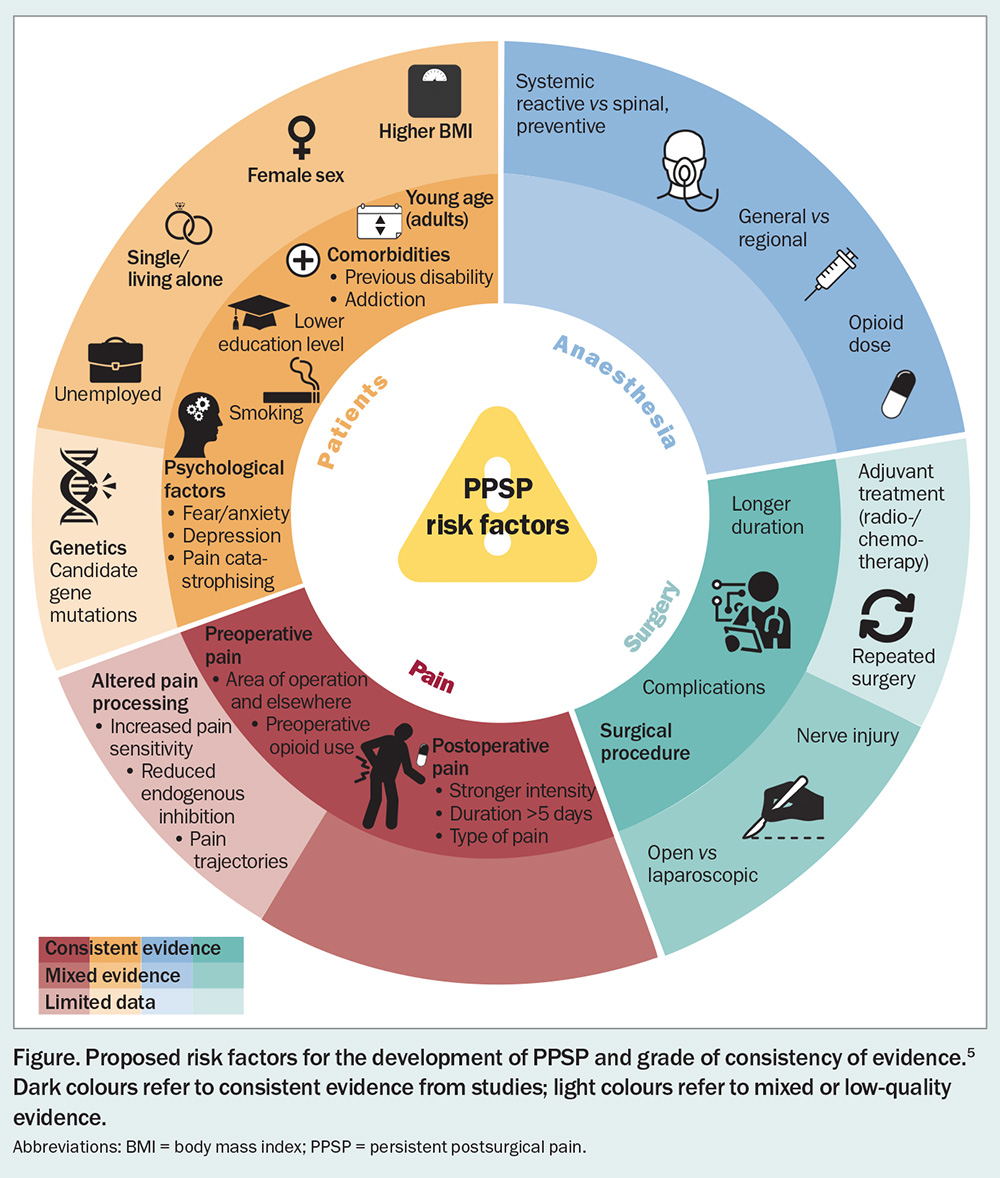
- patient factors
- anaesthesia
- surgical factors
- pain factors.
The most significant risk factors often cited by clinicians are poorly controlled pain in the entire perioperative period (including preoperative) and psychological factors.
These risk factors form the body of work of a transitional pain clinic, which by definition, is multidisciplinary in nature due to the variety of risk factors. The primary function of transitional pain clinics is the timely recognition of patients scheduled for surgeries that carry a substantial risk of PPSP and the systematic evaluation of their additional risk factors. These identified patients (preferably preoperatively, but more normally by a hospital’s acute pain service) are then managed early and offered early follow up with pain specialists and other members of the pain team as needed. The goal is preventing the development of PPSP but also yielding additional benefits such as minimising and managing opioid prescription. It is worth recognising at this stage that opioid prescription is strongly discouraged. According to a report from the US Centers for Disease Control and Prevention, 13.5% of patients on opioids for eight days to one month progress to long-term use, and this nearly doubles to almost 30% on opioids for more than 31 days.6 There is no reason to believe that the situation is any different in Australia.
The question is: how does this relate to community providers? Education in this area is valuable for all clinicians, and improved understanding may empower GPs to encourage specialists to consider these issues before initiating treatment. It also supports GP involvement in presurgical planning, postoperative monitoring for inadequately controlled pain, and the early recognition and referral of patients who may benefit from medical or allied health input. GPs and other primary care practitioners have unique contextual knowledge of their patients (particularly regarding long-term attitudes and behaviours) that can be leveraged specifically to act as care co-ordinators and to alert specialists if patients are at increased risk. Prior to referring patients for joint replacement, for example, GPs may consider highlighting some of the known preoperative risk factors. Their input in the consultation preoperatively would involve the risk factor alert to the hospital team. Postoperatively, their early diagnosis of neuropathic pain, institution of treatment and appropriate referral to members of the multidisciplinary team would be invaluable. Specific examples include using the Douleur Neuropathique 4 assessment tool for neuropathic pain, which is readily available online.
The team of acute hospital care and community working in harmony is the ideal model. Much of this harmony involves effective communication, with the discharge summary highlighting risk factors to monitor, potential plans for management and, at least, access to specialist advice. Additionally, there should be considerations regarding how to create a mechanism for primary care involvement in preoperative planning for patients with risk factors.
In real-world practice, early access to transitional pain services is often limited. As more pain units adopt transitional models, direct referral may allow for at least some degree of triage for high-risk patients. Elements of these models can also be delivered locally, where appropriate. For example, local psychologists with experience in cancer care (such as supporting patients undergoing mastectomy) may be well placed to provide key components of the intervention.
Chronic low back pain
One of the most significant, if not the most significant, epidemics remains low back pain. Globally, this is considered the leading cause of disability.7 Unlike ischaemic heart disease – where mechanisms, pathways and evidence-based interventions are well established – low back pain remains poorly understood. The field is often under-resourced and constrained by a shortage of high-quality evidence, yet it is often populated by a surfeit of providers delivering diverse and often inconsistent management techniques. There is reason to say there is little consensus between the different providers and often little communication, despite the well-established role for multidisciplinary pain management. Worryingly, low back pain cases are predicted to rise from 619 million cases worldwide in 2020 to 843 million in 2050.7
Unsurprisingly, the most notable risk factors associated with low back pain are occupational ergonomic factors (e.g. occupational exposure to lifting, bending, awkward postures, vibrations) and lifestyle factors (e.g. smoking and elevated body mass index).7 Other risk factors include higher pain intensity, depression, anxiety and a previous history of back pain.8 Many of these risk factors are described as ‘yellow flags’, and include other components such as a lack of social support, presence of compensation issues and unhelpful beliefs such as ‘pain equalling harm’ and pain catastrophisation. Many of these issues such as work factors and other yellow flags are targeted within chronic pain management programs or return to work programs for the injured worker. However, where pain management falls short is in the application of these principles as part of a preventive or transitional pain service.
Applying persistent postsurgical pain strategies to low back pain
Exploring what might change if patients were risk-stratified at their first GP or emergency department visit is of considerable interest. Early recognition would enable stratified care, with management targeted to the individual’s risk profile. Such an approach would require timely assessment, multidisciplinary management and appropriate follow up. Although the upfront costs would be high, when compared with the loss of productivity costs alone ($48 billion in 2018, according to the Deloitte report),2 a cost–benefit analysis may reveal important insights.
Several components would need to be addressed, and multiple barriers overcome, for such an approach to be implemented. The barriers are broadly educational, financial and logistical, although the target audiences are overlapping. Each layer in the sector, from the government and employer through to the individual healthcare provider and patient, requires addressing uniquely. The financial case, particularly for the government and employers along the lines of productivity, should show specifically that early intervention can mitigate more substantial long-term economic impacts.
Educating all healthcare providers in the chain on the importance of interdisciplinary collaboration is essential. Logistically, this involves providing enough specialist training positions and consultant posts to meet clinical demand. The Online Pain Education Network (https://openpaintraining.com/) is an example of a not-for-profit initiative to spread information on how to manage pain with an emphasis on self-management. Initiatives in the workplace targeting individuals at high risk of long-term pain and disability have proven to be highly successful.9 Unless these initiatives are expanded in scope and uptake, it is difficult to see how society will sustain the escalating healthcare and productivity costs associated with this rapidly growing issue.
In addition to early management preventing chronic pain, we are likely to see emerging evidence that more clearly differentiates effective treatments from those with limited utility. It is widely recognised among pain specialists that the longer a person has had chronic pain, the harder it becomes for any intervention to achieve lasting benefit. This reflects both the physiological changes that occur during the transition from acute to chronic pain and the psychological and behavioural adaptations that also require reversal or modification to enable recovery. As such, all aspects of chronic pain management, including medical, physical and psychological interventions, are under scrutiny, with many interventions proving less effective than once believed.
Hopefully, we will see a change in the future to the attitudes towards chronic pain as we continue to recognise the impact on wellbeing and, in turn, overall health in all domains of a person’s lived pain experience. As with many societal challenges, the least glamorous problems are often the most under-resourced yet may represent some of the greatest unmet needs. By focusing more on key domains such as activity, sleep and mood, as well as their main limiting factors, we may achieve preventive health improvements on a scale similar to that of established screening programs. All clinicians, from allied health professionals to primary care and hospital-based specialists, can contribute to targeted interventions, as suggested in conditions such as PPSP; yet, in many larger-scale issues, our efforts have only just begun. PMT
COMPETING INTERESTS: None.
References
1. Chronic Pain Australia (CPA). 2024 National Pain Report. Morningside: CPA; 2024. Available online at: https://chronicpainaustralia.org.au/wp-content/uploads/NPW_2024/CPA_2024_NATIONAL_PAIN_REPORT.pdf (accessed November 2025).
2. Deloitte. The cost of pain in Australia. Canberra: Deloitte Access Economics; 2019. Available online at: https://www.deloitte.com/au/en/services/economics/analysis/cost-pain-australia.html (accessed November 2025).
3. Macintyre PE. The opioid epidemic from the acute care hospital front line. Anaesth Intensive Care 2022; 50: 29-43.
4. Clarke H, Waisman A, Aternali A, et al. Ten years of transitional pain service research and practice: where are we and where do we go from here? Reg Anesth Pain Med 2025; 50: 188-203.
5. Rosenberger DC, Pogatzki-Zahn EM. Chronic post-surgical pain – update on incidence, risk factors and preventive treatment options. BJA Educ 2022; 22: 190-196.
6. Shah A, Hayes CJ, Martin BC. Characteristics of initial prescription episodes and likelihood of long-term opioid use – United States, 2006–2015. MMWR Morb Mortal Wkly Rep 2017; 66: 265-269.
7. GBD 2021 Low Back Pain Collaborators. Global, regional, and national burden of low back pain, 1990–2020, its attributable risk factors, and projections to 2050: a systematic analysis of the Global Burden of Disease Study 2021. Lancet Rheumatol 2023; 5: e316-e329.
8. Nieminen LK, Pyysalo LM, Kankaanpää MJ. Prognostic factors for pain chronicity in low back pain: a systematic review. Pain Rep 2021; 6: e919.
9. Nicholas MK, Costa DSJ, Linton SJ, et al. Implementation of early intervention protocol in Australia for ‘high risk’ injured workers is associated with fewer lost work days over 2 years than usual (stepped) care. J Occup Rehabil 2020; 30: 93-104.
Single article purchases are temporarily unavailable due to site maintenance.
If you would like to purchase an article during this time, please email us at [email protected] with the article details and we'll assist you directly. We'll also let you know when online purchasing is available again.
Thank you for your patience and understanding.