
Managing cancer pain – a practical guide to the appropriate use of opioids

Pain is one of the most feared symptoms of advanced cancer. Adequate pain treatment is achievable in most patients and results in clinically relevant improvements in health-related quality of life. The Cancer Council Australia Cancer Pain Management in Adults Clinical Guidelines provide clinicians with practical guidance about opioid and nonopioid pain management strategies in patients with cancer pain.
Commentary from the Editor-in-Chief
This article by Dr Elina Gourlas and Professor Melanie Lovell gives a practical account of prescribing analgesia for cancer patients, including a reference to the Cancer Council Australia Cancer Pain Management in Adults Clinical Guidelines. These recommendations include an emphasis on clarifying the diagnosis and the nonpharmacological treatment options. This relates to the fact that many people are living with cancer for long periods of time, so their chronic noncancer pain may be an issue, as well as pain caused by treatment for cancer. It’s also important to note that nonpharmacological treatments should go alongside appropriate medications in most cases. We know that patients presenting for specialist management for cancer pain have similar psychological profiles to those with chronic noncancer pain, and can benefit from advice about exercise and cognitive-behavioural pain management techniques, as well as counselling and family therapy. Having said this, it’s important not to be ‘opiophobic’ in the treatment of cancer pain, and to ensure patients with moderate to severe pain receive guideline-adherent analgesia. The prescription authority system can be used to supply adequate amounts of medication to cancer patients and reduce the burden of frequent consultations. Practical advice is given about this. In some patients with neuropathic pain or opioid-related nausea or constipation, tapentadol can be useful because of its two-pronged action. However, it has a dose limit and some patients cannot take tapentadol due to its side effects. Changing to another opioid (usually oxycodone or morphine) should always be considered if it is ineffective or not tolerated in cancer patients.
Editor-in-Chief,
Associate Professor Charles Brooker
MB ChB, MRCP, FANZCA, FFPMANZCA
Clinical Associate Professor,
Northern Clinical School,
The University of Sydney, Sydney, NSW
- Pain is one of the most feared symptoms of advanced cancer and is associated with poorer outcomes for cancer patients.
- Adequate pain management can be achieved in most patients and results in clinically relevant improvements in health-related quality of life.
- Screening for and assessment of cancer pain is a key component of treatment that should be routinely incorporated throughout cancer care.
- Cancer pain management should involve a patient-centred approach with an understanding of what pain means for the patient and their family or carers.
- Opioids continue to be the mainstay of management for moderate to severe cancer pain, and guidance on pain management strategies is provided in the Cancer Council Australia Cancer Pain Management in Adults Clinical Guidelines.
- Refractory pain that is unresponsive to increasing opioid doses may require the use of adjuvant analgesics or opioid rotation.
- Pain that has changed in character and new sites of pain require comprehensive assessment.
- Referral to a specialist palliative care service can facilitate additional support in managing pain in patients with cancer.
Cancer pain is one of the most common and problematic symptoms faced by people requiring palliative care.1 It is also one of the most feared symptoms of advanced cancer.2 Over one-third of patients describe pain related to cancer as distressing or even as an intolerable aspect of their cancer.3 Uncontrolled pain delays healing and recovery, leading to poorer outcomes for cancer patients.4 Evidence suggests that adequate pain treatment results in clinically relevant improvements in health-related quality of life and that cancer pain can be well controlled in up to 90% of cases.5,6
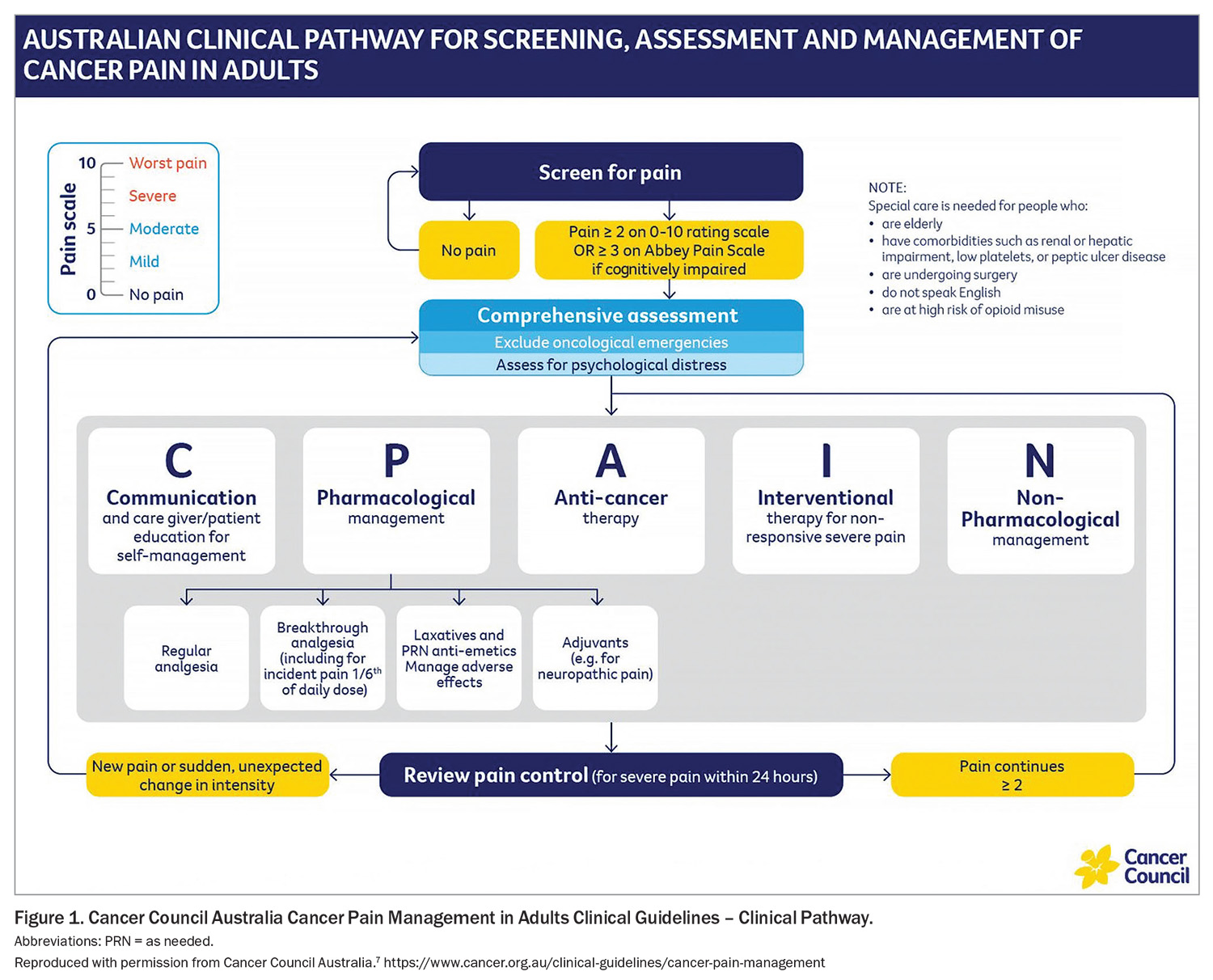
GPs play a crucial role in ensuring timely, safe and effective pain management, particularly in community and primary care settings. With increasing concerns over opioid misuse and the complexities of prescribing in the context of regulatory frameworks, it is important that GPs are appropriately supported to feel confident in the use of opioids for cancer-related pain. This article provides a comprehensive overview of the assessment and management of cancer pain and appropriate opioid prescribing in cancer care, referring to Australia’s national Cancer Pain Management in Adults Clinical Guidelines, issued by Cancer Council Australia (Figure 1, available online at https://www.cancer.org.au/clinical-guidelines/cancer-pain-management).7
Screening for and assessing cancer pain
The initial and ongoing assessment of pain is a key component of treatment that should be routinely incorporated throughout cancer care. It helps in determining the need for further comprehensive assessment. Risk factors for poor pain control include:
- high pain scores
- cognitive impairment
- older age (because of changed pharmacokinetics and dynamics, and the resultant narrow therapeutic window, in addition to communication difficulties in cognitively impaired patients)8
- history of substance use
- first language other than English
- membership of a cultural minority group
- neuropathic pain.
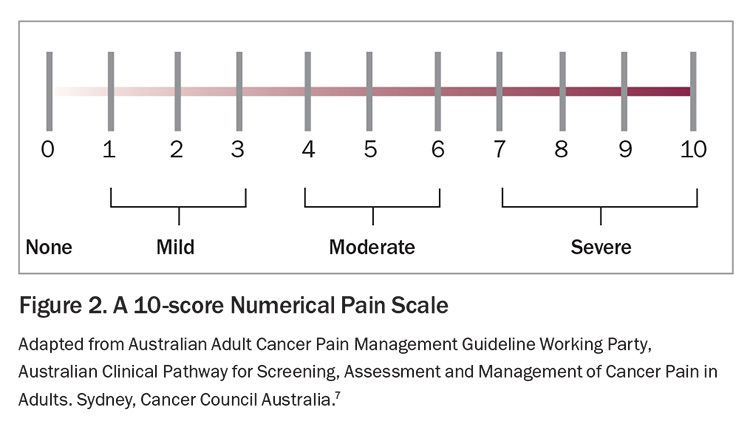
For all patients who are able to communicate their level of pain, it is suggested that at each clinical encounter, clinicians should assess their worst and average pain intensity during the previous 24 hours using a self-reported numerical rating scale from zero to 10, where zero represents ‘no pain’ and 10 represents the ‘worst pain you can imagine’ (Figure 2).7 The Wong-Baker FACES Scale is useful for patients aged over three years of age who find it easier to rate their pain using pictures rather than numbers (https://wongbakerfaces.org). Examples of scales for people with cognitive impairment include the Abbey Pain Scale and the PAINAD.
A patient-centred psychosocial approach
It is important to maintain a patient-centred approach, incorporating an understanding of what pain means for the patient and their family or carers. An assessment of any concerns the patient has about the pain or treatments is also important as this may impact on their acceptance of certain treatments or compliance. Concerns may include fear of addiction, tolerance, side effects or fear that prescription of opioids indicates the final phase of illness. Some suggested questions from the Cancer Pain Management in Adults Clinical Guidelines to identify patient concerns include the following.
- What do you think is causing the pain?
- Has someone else in the family had cancer pain?
- Is there anything you are afraid of related to the pain or its management?
- Is there anything that worries you about the treatment of pain?
Understanding cancer pain
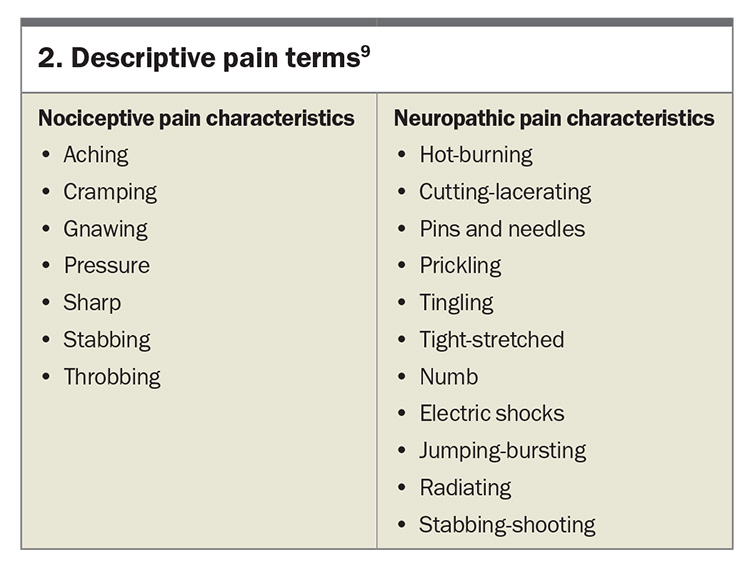
Cancer pain can be classified as nociceptive (somatic or visceral), neuropathic or mixed (Box 2).9 Pain may arise from the tumour itself, cancer treatments (e.g. surgery, chemotherapy, radiotherapy) or unrelated comorbidities. Assessment should be multidimensional, encompassing pain intensity, character, temporal pattern, psychological impact and functional interference. Anti-cancer treatments that may cause peripheral neuropathy include taxanes, platinum agents, eribulin, vincristine, navelbine, lenolinamide, bortezomib and thalidomide.
Principles of cancer pain management
Key principles of cancer pain management include: regular assessment and documentation; individualised treatment plans; regular analgesia for constant pain (moderate to severe cancer pain is likely to need opioid treatment); use of adjuvants for neuropathic pain (e.g. amitriptyline, gabapentinoids); early referral to specialist palliative care when appropriate; and consideration of referral for interventional pain management techniques, when appropriate.
The Cancer Pain Management in Adults Clinical Guidelines recommend a structured approach to analgesia, based on the WHO analgesic ladder and updated for modern clinical practice:
- mild pain: nonopioid analgesics (e.g. paracetamol, NSAIDs)
- moderate pain: low dose strong opioids or weak opioids
- severe pain: strong opioids (e.g. morphine, oxycodone, hydromorphone, fentanyl)
- adjuvants as needed for specific pain syndromes.
There is no significant evidence to support or refute the use of paracetamol and NSAIDs, either by themselves or in combination with opioids. If cancer pain is moderate or severe, or continues despite treatment with paracetamol or NSAIDs, low doses of strong opioids are appropriate as an alternative to the use of weak opioids, which have limited roles in the management of cancer-related pain. Codeine is one example, with complex pharmacodynamics and variability in individual responses based on an individual’s ability to convert codeine to morphine. At one extreme, some patients are poor metabolisers (about 5 to 10% of the population), who experience very little therapeutic effect from codeine, and, at the other extreme, some are ultra-rapid metabolisers (up to 10% of the White population and 30% of the African population), who have increased conversion of codeine to morphine, leading to a higher risk of toxicity.
Tapentadol is another example. It is a novel, centrally-acting analgesic agent with a dual mechanism: mu-opioid receptor agonism with noradrenaline reuptake inhibition in the same molecule. Although tapentadol has become increasingly used as an alternative to other opioids, it is not always the most suitable option. Tapentadol has a similar side effect profile to more traditional opioids, despite the heavily industry-funded evidence suggesting otherwise. It is also costly for patients because the immediate-release (IR) formulation is not PBS subsidised. More importantly, it is essential that prescribers understand the opioid equivalence of tapentadol compared with oral morphine. The dose conversion of tapentadol to morphine is about 0.3, where a single 50 mg tapentadol is equivalent to about 15 mg of oral morphine, and 100 mg of tapentadol is equivalent to about 30 mg of oral morphine. In frail and elderly patients, this is of particular concern and caution with dosing is needed.
Role of opioids in cancer pain management
Opioids continue to be the primary treatment for managing moderate to severe cancer-related pain. The safe and judicious use of opioid medications in cancer pain is well supported by evidence and is considered appropriate across all stages of illness and treatment intent, including curative, palliative and end-of-life care.
Opioid choice
Morphine
Morphine is often the first-line strong opioid in the hospital setting because of its familiarity, cost-effectiveness and flexibility in formulations. However, alternatives may be preferred in certain situations, particularly in the community.
Oxycodone
Oxycodone is about 1.5 times more potent than morphine but has a similar efficacy and side effect profile. It is suitable for use in patients with renal impairment. Oxycodone is available in modified-release (MR) and IR tablets and liquid form. It is also available in an MR tablet combined with naloxone.
Liver metastases appear to be associated with a systemic effect of naloxone, despite normal or only mildly abnormal liver function. Therefore, combination formulations of oxycodone and naloxone should be avoided in patients with liver metastases or deranged liver function tests. Caution should be observed with switching from these formulations to another opioid (particularly when using higher doses – above 20 to 30 mg twice daily – and in hepatic impairment), as there may be some systemic effect of naloxone. If a patient with liver impairment is changed from oxycodone with naloxone to a single opioid formulation, a lower equivalent dose of the new opioid should be used to start with (i.e. 50% of the approximate equianalgesic dose) and the patient should be monitored carefully for adverse effects or toxicity.
Buprenorphine
Buprenorphine patches are useful for patients with stable opioid requirements and difficulty swallowing. They are safe in renal and hepatic impairment, and can be useful in elderly patients with lower pain scores because of the relatively low potency (buprenorphine 5 mcg patch is equivalent to about 12 mg oral morphine over 24 hours). The buprenorphine patch half-life is about 26 hours and it can take up to 72 hours to reach steady state.
Fentanyl
Fentanyl patches are useful for patients with stable opioid requirements and difficulty swallowing. They are safe in renal impairment. Care needs to be taken with dose titration because of the potency of fentanyl and the large dose increments between available formulations. A 12 mcg fentanyl patch is equivalent to about 30 mg oral morphine over 24 hours. The half-life of a fentanyl patch is 13 to 22 hours.
Sublingual or buccal fentanyl can be useful when patients are receiving at least 60 mg oral morphine equivalent and are unable to swallow, and in other situations in which the oral route is not available, or when other routes are impractical or inappropriate. It can be effective in breakthrough pain where background cancer pain is controlled but the patient has incident pain (intermittent but predictable pain related to a specific precipitant, for example movement or dressing changes) or moderate to severe pain that occurs spontaneously but may not last long.
Hydromorphone
Hydromorphone is suitable for patients with renal impairment. Its use is best managed with specialist palliative care input as it is five times more potent than morphine and there are limited preparations available in the community.
Methadone
Methadone has a complex pharmacodynamic and pharmacokinetic profile, with significant individual patient variation in metabolism. Although minimal renal excretion makes methadone a suitable opioid for uraemic patients, obstructive hepatic failure and other drug interactions in hepatic metabolic pathways, as well as individual variation, can lead to a widely variable plasma half-life (in the range of 5 to 130 hours), requiring between four and seven days to reach steady state, and a risk of accumulation. It should be managed with specialist palliative care input.
Initiation and titration
Opioids should be started at the lowest effective dose and titrated based on regular pain assessment. Patient-recorded pain diaries can provide invaluable information about analgesic response and requirements. When initiating and titrating treatment:
- start with the lowest possible dose to achieve acceptable analgesia and patient goals
- use IR preparations for titration. For some patients, it may be appropriate to initiate opioids with a MR formulation (caution with this is required in patients with renal or hepatic impairment, opioid naïve patients and the elderly)
- have patients record their pain score, analgesia taken and the response
- convert to MR formulations once background pain is well controlled overall and the total daily dose to achieve this is established
- provide clear guidance on breakthrough pain management
– typically prescribe a breakthrough analgesia dose (as IR) that is one-sixth of the total daily dose of equivalent opioid. For example, if a patient is taking oxycodone MR 15 mg twice daily, the breakthrough dose of oxycodone IR would be 5 mg
– it is safe and appropriate to prescribe breakthrough analgesia up to every two hours, with a maximum of six doses in 24 hours. Patients and their families or carers require education about the signs of opioid toxicity – mainly drowsiness or pinpoint pupils – and when to seek help - closely monitor and review patients when initiating and titrating opioid analgesia or in the setting of unstable pain
- consider increasing the regular dose of opioid to incorporate the rescue doses taken in the previous 24 hours, then reassess pain severity and adverse effects within 48 hours
- take care when calculating a new regular dose for people who are pain-free at rest but have pain on movement (incident pain). If all the analgesia for this pain is incorporated into the new regular opioid dose, patients may become opioid toxic and excessively sleepy at rest. This is because pain is a physiological antagonist to the sedative and respiratory depressant side effects of opioids.
When considering the introduction of rapid-acting opioids, for example sublingual or buccal fentanyl, patients must have been on a stable dose of a regular opioid for at least seven days (equivalent to at least 60 mg of oral morphine or 40 mg of oral oxycodone in 24 hours or a 25 mcg/hour fentanyl patch) before rapid-acting fentanyl is used.
There are three fentanyl formulations registered in Australia and on the PBS: a sublingual tablet, an orally disintegrating tablet and a buccal lozenge on a stick. There are clinically important differences in their rate and extent of absorption and they are not equivalent on a microgram:microgram basis with each other or with any other fentanyl products. Fentanyl products should not be used interchangeably as incorrect substitution or switching may result in fatal overdose. The lowest dose of the sublingual (100 mcg), orally disintegrating (100 mcg) or buccal (200 mcg) fentanyl tablet should be used as the initial dose. If the patient can be monitored and is not at risk of opioid toxicity, a second tablet can then be given after 15 to 30 minutes, if required. Patients should be advised to wait for two hours before treating another episode of breakthrough pain, with a maximum of four doses in 24 hours. Rapid-acting fentanyl should be discontinued if it is ineffective or no longer needed.
Opioid rotation
Switching opioids or ‘opioid rotation’ may be required because of side effects or inadequate pain relief. It is a change in opioid drug or route of administration with the goal of improving outcomes. Analgesic dose equivalent charts and opioid calculators, such as the Australian and New Zealand College of Anaesthetists calculator (https://www.anzca.edu.au/safety-and-advocacy/opioid-calculator), provide guidance but should be adjusted for incomplete cross-tolerance, typically reducing the calculated dose by 25 to 40% when switching.
Monitoring and managing side effects
Opioid-related side effects can include constipation, nausea, sedation, cognitive impairment, respiratory depression and, although rare in cancer patients, addiction. Suggested strategies for managing these side effects are listed below.
- Constipation
– always prescribe laxatives preventatively (e.g. stimulant plus softener, using caution with stimulants in the setting of peritoneal disease or suspected bowel obstruction) - Nausea
– usually self-limiting at the time of initiation of opioids
– provide an antiemetic in case of nausea (good first-line options include metoclopramide 10 mg three times daily before meals, as needed, or haloperidol 0.5 mg twice or three times daily, as needed)
– proactive management of constipation and treatment of any underlying gastro-oesophageal reflux disease should also be considered - Sedation
– mild sedation is often transient; consider dose adjustment if persistent
– significant sedation should not occur with the initiation of opioid analgesia - Cognitive impairment or delirium
– evaluate for other causes
– consider dose reduction or rotation - Respiratory depression
– rare when opioids are titrated slowly; naloxone is very rarely needed in cancer pain contexts - Addiction
– an often-feared side effect when opioids are initiated but rare in cancer patients
– care should be taken in patients with a history of substance use disorder, balancing the need for comprehensive cancer pain management and effective analgesia with appropriate safeguards.
Red flags and points to consider
Refractory pain that is unresponsive to increasing opioid doses may require the use of adjuvant analgesics (e.g. gabapentinoids for neuropathic pain) or opioid rotation; consider referral to a specialist palliative care service in these situations. Pain that has changed in character and new sites of pain require comprehensive assessment. It is important to query whether the pain fits with the patient’s diagnosis and location of the patient’s disease, and to remember that not all pain in patients with cancer is cancer-related pain. It is also important to consider whether the pain is related to an oncological emergency, for example a bone fracture (or high risk of imminent fracture), central nervous system metastasis (brain, epidural or leptomeningeal), spinal cord compression, infection, or an obstructed or perforated abdominal organ.
Navigating regulatory frameworks and steps to prescribing
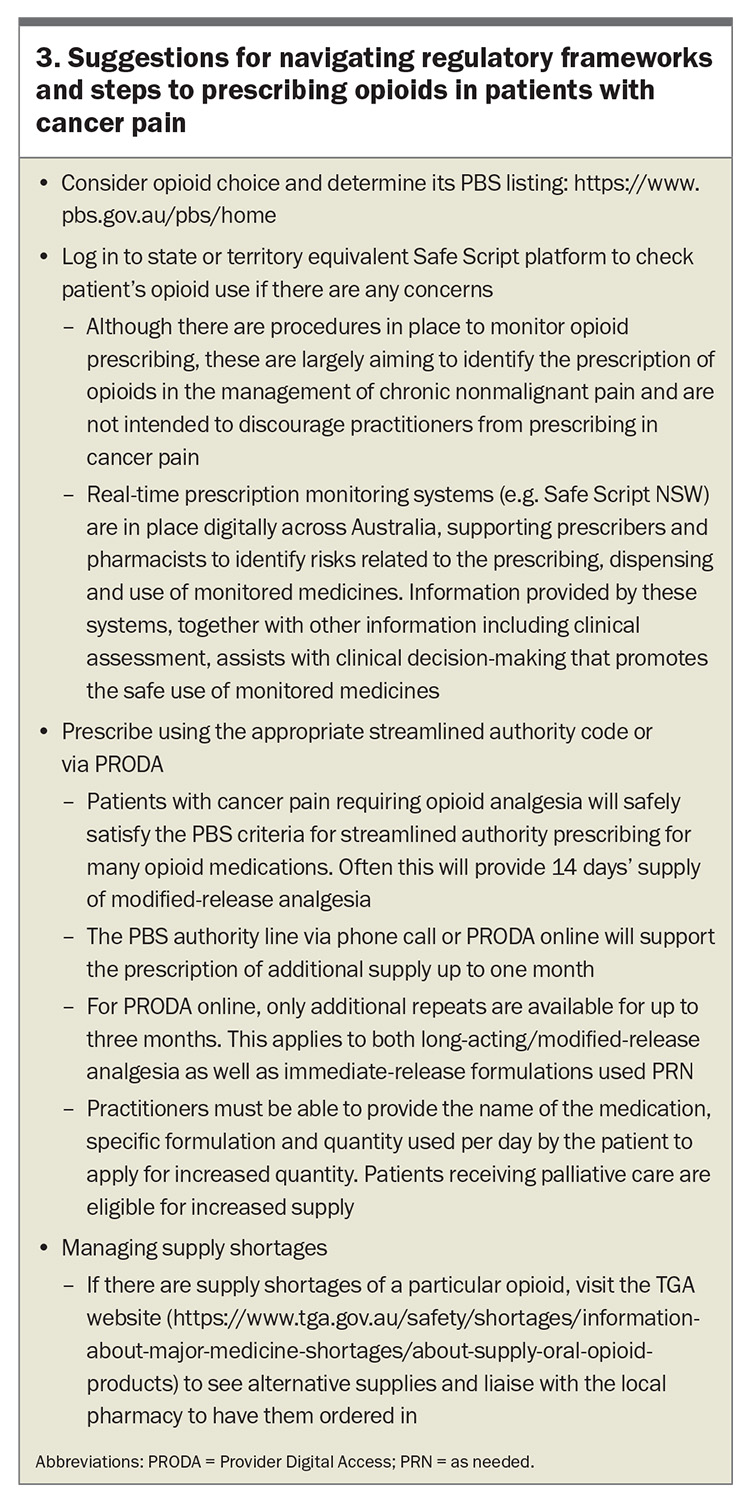
Box 3 provides suggestions for how to consider opioid choice and determine its PBS listing, navigate the regulatory frameworks and steps to prescribing, including managing supply shortages.
Conclusion
Opioids continue to be the mainstay of management for moderate to severe cancer pain. People living with cancer pain depend on their GPs for comprehensive assessment and access to appropriate treatment, including opioids. GPs needing support in prescribing can refer to their local palliative care service for advice to ensure patients can have optimal pain relief and enjoy the best possible quality of life. PMT
COMPETING INTERESTS: Professor Lovell is Chair of the Working Party for the Cancer Council Australia Cancer Pain Management in Adults Guideline and has received support from the Asia Pacific Hospice Network for conference registration to speak on the Australian Cancer Pain Guidelines. Dr Gourlas: None.
References
1. Van den Beuken-van Everdingen MH, Hochstenbach LM, Joosten EA, Tjan-Heijnen VC, Janssen DJ. Update on prevalence of pain in patients with cancer: systematic review and meta-analysis. J Pain Symptom Manage 2016; 51: 1070-1090.
2. Davis MP, Walsh D. Epidemiology of cancer pain and factors influencing poor pain control. AJHPM 2004; 21: 137-142.
3. Breivik H, Cherny N, Collett B, et al. Cancer-related pain: a pan-European survey of prevalence, treatment, and patient attitudes. Ann Oncol 2009; 20: 1420-1433.
4. Nersesyan H, Slavin KV. Current approach to cancer pain management: availability and implications of different treatment options. Ther Clin Risk Manag 2007; 3: 381-400.
5. Puetzler J, Feldmann Jr RE, Brascher AK, Gerhardt A, Benrath J. Improvements in health-related quality of life by comprehensive cancer pain therapy: a pilot study with breast cancer outpatients under palliative chemotherapy. Oncol Res Treat 2014; 37: 456-462.
6. Vargas-Schaffer G. Is the WHO analgesic ladder still valid? Twenty-four years of experience. Can Fam Physician 2010; 56: 514-517.
7. Cancer Council Australia. Cancer Pain Management in Adults Clinical Guidelines. Sydney: Cancer Council Australia. Sydney. Available online at: https://www.cancer.org.au/clinical-guidelines/cancer-pain-management (accessed July 2025).
8. Brant JM. Assessment and management of cancer pain in older adults: strategies for success. Asia Pac J Oncol Nurs 2018; 5: 248-253.
9. Bennett M. The LANSS Pain Scale: the Leeds assessment of neuropathic symptoms and signs. Pain 2001; 92: 147-157.
Single article purchases are temporarily unavailable due to site maintenance.
If you would like to purchase an article during this time, please email us at [email protected] with the article details and we'll assist you directly. We'll also let you know when online purchasing is available again.
Thank you for your patience and understanding.